Floralie Resa
Translation from « Architecture de la biphobie » published originally the 16th of January 2025.
Summary
Theoretical essay on the origins and manifestations of systemic biphobia. In contrast to the ideas developed by Eisner, it situates biphobia as an autonomous product of homophobia rather than of sexism, and proposes a new theoretical framework supported by case studies and statistics. Ranging from domestic violence to media coverage of studies on the excess mortality of bisexual women compared to lesbian and heterosexual women, this report offers a simple structure for understanding the difference between homophobia and biphobia in a historical and international context.
Preamble
The theorization of biphobia is sparse and often confined to accounts of everyday microaggressions: a guy asked me for a threesome, someone claimed bisexuality doesn’t exist, or a lesbian was mean to me. This lack of depth, in my view, stems from the fact that bi people who are passionate about theory don’t spend enough time together for their ideas to mutually enrich one another.
In activist circles, we often underestimate the time and labor required to develop the theoretical frameworks that help us understand oppression. We read books on these topics, we discuss them, and we overlook how much time, reflection, and collective dialogue was necessary for these concepts to be rendered clear. Theorization, including that of biphobia, relies on collective intellectual labor.
I conducted research in the experimental sciences for several years and witnessed how flashes of insight and fleeting inspirations emerge from exchange and dialogue among specialists. We talk constantly, read each other’s work, experiment on our own, excited to share results, and we debate. Long before a theory is proven, it must first be imagined and tested. Theory-building happens collectively, through real-life discussion or through reading and drawing inspiration from others’ work. Our ideas bounce off one another, growing richer in the process.
So, before proceeding any further, I would like to acknowledge the bi individuals whose ideas have resonated with mine, whether directly or through their writings, or who have enabled my own theorization by offering time and attentive listening. Within my circle of bi and pan friends, there is Eliot Astree, Axiel Cazeneuve, and Precarité Inclusive, known as Préca. Eliot and Axiel are my comrades-in-arms. We have written and spoken so much together that whatever the topic, if I become interested in an idea, they inevitably hear about it. Préca is as passionate as I am about bisexuality, and we have had extensive debates on these subjects.
On the theoretical front, I must highlight the influence of Stéphanie Ouillon (Wohosheni), Julia Shaw, and Autumn Bermea. Stéphanie Ouillon is an engineer and independent researcher on the history of bisexuality as it relates to French gay activism. Julia Shaw, a German criminologist, has made accessible a significant body of research on bisexuality. Autumn Bermea is a clinical psychology researcher who co-authored one of the most important peer-reviewed articles on the violence experienced by bi women in their relationships. That article had a profound impact on my activism, as it gave me language to articulate the violence I had endured and opened my eyes to the effects of biphobia I had previously only witnessed.
My patrons and those who support my work on Instagram have also deeply motivated me to write and reflect. I am immensely grateful to them for the platform they have offered me.
I have an ambivalent relationship with the work of Shiri Eisner, whose writings I postponed reading until after most of my own had been completed. I came across fragments of her texts as bi activists shared her work. Yet I cannot deny the tremendous influence she has had on bi thought. As for Robyn Ochs and Julia Serano, they have deeply shaped my thinking, so embedded are their ideas in contemporary bi discourse. I simply did not know who they were or that they had authored so much of what is now considered mainstream. Robyn Ochs is a bi activist who has extensively theorized biphobia through the lens of invisibility. Julia Serano, a trans and bi activist, has written prolifically on binaries and bisexuality. Her influence on transfeminist thought often overshadows her contributions to bisexual theory, yet she remains a major theorist in that domain.
There are other names, now invisible, forgotten, that have also shaped bisexual thought.
It seemed essential to begin by recalling the collective nature of how bi thought has been built thus far, and the crucial role that the circulation of ideas has played. I have benefited from those who transmitted others’ ideas to me, and from those who shared my work. I would therefore like to end this preamble with a quote from a French lesbian speaker, Nathalie Sejan:
“We often feel powerless or useless in an age of virality and large-scale influence, but my experience is that consciously circulating the things we love and that matter to us is a powerful way to shape the tone of society and general trends. The world is a collective endeavor; circulation is an effective tool that all of us can use freely and continuously. So I circulate.”
Introduction
The term “homophobia” was not the one initially used when gay people began theorizing their oppression. Stéphanie Ouillon (Wohosheni), a specialist in the history of bisexuality in France who has worked extensively with 1970s archives from the Front Homosexuel d’Action Révolutionnaire (FHAR), explains: “At that time, the word ‘homophobia’ didn’t yet exist in France. The expression ‘anti-homosexual racism’ was widely used instead” (Wohosheni 2024-a). To convey their experiences to the general public, it was easier to draw on the concept of an already recognized oppression such as racism, unlike homophobia, which had not yet benefited from the same history of activist analysis. It took years of intellectual and political labor to theorize what homophobia was, how it manifested, and how it affected homosexual people. Just as the term “homophobia” took years to gain public recognition, biphobia today faces similar, if not more complex, challenges.
The term “biphobia” is used by bisexual people to name their oppression. Today, while homophobia is widely recognized and understood as a real and systemic form of discrimination, biphobia is not. It remains poorly understood. Much like gay activists once struggled to articulate what has now become widely accepted knowledge, bisexual thinkers today are also working to define and theorize what biphobia actually is. What I have learned through bi activism is that speaking about biphobia often provokes highly defensive reactions within the LGBT community itself, as well as significant misunderstanding in the heterosexual majority. Why does biphobia remain so poorly understood and under-recognized, and how can we theorize this oppression in a way that is both specific and systemic?
This essay is structured in four parts in order to clarify the architecture of biphobia, its origins and its systemic manifestations. In the first part, I will summarize the current state of biphobia theorization and present the most prominent conceptual frameworks to date. In the second part, I will argue for what I believe to be the true origin of biphobia as a specific form of oppression and introduce a new theoretical framework that accounts for the social structures sustaining it. The third part will focus on distinguishing between lesbophobia and biphobia. Finally, in the fourth and last part, I will illustrate the most significant manifestations of systemic and institutional biphobia.
Part 1 – Where Does the Conceptualization of Biphobia Stand Today?
Several activists and intellectuals have contributed to the development of a bisexual understanding of biphobic oppression. Julia Serano defines biphobia as follows: “Often literally read as a “fear of” or “aversion to” bisexual people. I typically use the term in a broader manner to describe the belief or assumption that bisexuality is inferior to, or less legitimate than, monosexuality (i.e., being exclusively attracted to members of a single gender/sex)” (Serano 2016).
In this section, I will focus only on those theorists who have had the most significant impact within the bisexual community and whose work on the origins of biphobia has been the most widely circulated. The first person I will mention is Robyn Ochs.
1. Definitions ans Theoretical Contributions
Robyn Ochs : The Erasure of Bi People as an Accident of a Binary American Culture
Robyn Ochs is an American bisexual activist and author. She has written extensively on institutionalized biphobia, that is, biphobia that stems not from individuals, but from systemic structures. Ochs’s work has focused on biphobia as the erasure of bisexuality from both public and LGBT discourses (Ochs 1996). Her activism has centered on increasing bisexual visibility. She is the co-author of two major works on the subject: Getting Bi: Voices of Bisexuals Around the World (2005) and Recognize: The Voices of Bisexual Men (2014).
According to Ochs, bisexual erasure stems partly from monogamy and partly from a binary cultural framework. Bi people, often in monogamous relationships, are not immediately identifiable as bisexual, since they are seen with only one partner at a time. In an article published in the Huffington Post (Zane 2016), Ochs also argues that the United States’ deeply ingrained culture of binarity, reflected in everything from racial segregation to the two-party political system, contributes to biphobia.
Ochs is one of the most prolific and well-known bisexual activists, particularly recognized for her conceptualization of bisexuality. Her definition is frequently cited: “I call myself bisexual because I acknowledge that I have in myself the potential to be attracted–romantically and/or sexually–to people of more than one gender, not necessarily at the same time, in the same way, or to the same degree.” (Ochs, date unknown).
While Ochs has identified biphobia as present both within LGBT communities and broader society, she appears to attribute it largely to chance or cultural bias. Unlike Ochs, who interprets biphobia as a byproduct of binary cultural norms, Kenji Yoshino analyzes it as an intentional social mechanism.
Kenji Yoshino: The Erasure of Bisexuality as a Tool for Maintaining Norms
Kenji Yoshino is an American legal scholar and a gay man. He explored the mechanisms behind bisexual erasure in a legal article addressing U.S. sexual harassment jurisprudence. His article The Epistemic Contract of Bisexual Erasure, published in 2000, has had a major impact and has been cited over 700 times.
According to Yoshino, bisexual erasure is the result of a social contract between heterosexual and homosexual communities, both of which have shared interests in suppressing mentions of bisexuality. He identifies three motivations for this erasure: the stabilization of exclusive sexual orientation categories; the maintenance of sex as a “diacritical” axis (i.e., one that creates an unsolvable contradiction and serves to categorize humans into two distinct sexes); and the preservation of monogamous norms (Yoshino 2000). In short, biphobia, for Yoshino, fulfills a social need to stabilize human classification along both sexual and gendered lines, while reinforcing monogamy as a normative ideal. In this reading, bisexuality is framed as a disruptive force, an agent of transgression, that both heterosexuals and homosexuals seek to eliminate.
Yoshino’s vision of biphobia has had a profound influence on bisexual thought. Similar ideas appear in Michael Amherst’s 2018 work, where biphobia is described as a cultural fear of ambiguity and nonconformity, highlighting bisexuality’s inherent fluidity (Amherst 2018). Yoshino’s impact is particularly evident in the work of Shiri Eisner, an Israeli bisexual activist and writer. Eisner cites Yoshino’s arguments extensively in her book Bi: Notes for a Bisexual Revolution (2013), and builds on them by framing biphobia as driven by the need to maintain binary systems and normative structures around monogamy and family.
Over a third of Eisner’s chapter Monosexism and Biphobia is devoted to summarizing Yoshino’s 2000 article, underscoring the central influence his analysis had on her thinking. Inspired by Yoshino’s work, Eisner goes a step further by proposing a broader structural framework that she terms monosexism.
Shiri Eisner: Monosexism as a Social Structure that Oppresses Bi People and Privileges Heterosexuals, Gays, and Lesbians
Shiri Eisner is one of the most well-known activist figures in bisexual movements, particularly due to her book Bi: Notes for a Bisexual Revolution (2013). In it, she introduces the term monosexism to describe a patriarchal and colonial structure of oppression that, in her view, lies at the root of biphobia. Eisner popularized the use of the word monosexism, modeled on heterosexism, which has long been used to theorize the oppression of women and of gay and lesbian individuals.
In her book, Eisner strongly criticizes prevailing discourse within bisexual spaces, which she accuses of being overly liberal and focused on isolated, individual acts of oppression, rather than on systemic and structural dimensions. Through this critique, she highlights the lack of biphobia theorization in the early 2010s. While Yoshino’s work forms a major foundation of her thinking, she also cites several other key sources that help her articulate a more comprehensive analysis of biphobic oppression. Chief among these are Robyn Ochs’s work on prejudice and stereotypes about bisexuals, and the writings of Miguel Obradors-Campos, who applied Iris Marion Young’s theories of oppression to bisexuality.
Iris Marion Young, an American political theorist, characterized the oppressions experienced by minorities according to five axes: exploitation, marginalization, powerlessness, cultural imperialism, and violence. Obradors-Campos adapted these categories to the context of biphobia in a scholarly article (Obradors-Campos 2011), which Eisner then popularized in her book. As with Yoshino’s theory, Eisner devotes over a third of the chapter Monosexism and Biphobia to summarizing Obradors-Campos’s work, demonstrating its strong influence on her own theorization.
However, Eisner does not merely popularize existing theories; she also expands the field with her own original contribution: the concept of monosexual privilege. She proposes a list of privileges granted to people she terms monosexuals, that is, heterosexuals, gays, and lesbians. Among her list of 29 monosexual privileges are examples such as:
- “Society assures me that my sexual identity is real and that people like me exist.”
- “I feel welcomed at appropriate services or events that are segregated by sexual identity (for example, straight singles nights, gay community centers, or lesbian-only events).”
- “I do not need to worry about potential partners shifting instantly from amorous relations to disdain, humiliating treatment, or verbal or sexual violence because of my sexual identity.” (Eisner 2013)
In sum, Eisner has theorized the concept of monosexual privilege, coined and popularized the term monosexism, and helped disseminate and make accessible two major theoretical contributions to the understanding of biphobia: Yoshino’s epistemic contract and Obradors-Campos’s structural application of Young’s framework.
2. Quantifying the Effects and Establishing Scientific Consensus
Researching Biphobia: A Scientific Endeavor
The general public often minimizes the scientific legitimacy of the humanities. Yet the humanities are sciences, it is important to reiterate this. Theories about biphobia must be tested to be validated. While all theories on biphobia are grounded in argumentation, only some have been empirically verified.
For instance, certain theories proposed by Robyn Ochs have undergone scientific testing and validation. This includes her theory of double discrimination, wherein bisexual individuals experience stigma from both heterosexual and gay/lesbian communities. Empirical studies have confirmed the existence of such stigma coming from heterosexuals, as well as from gays and lesbians (Welzer-Lang 2008; Mulick & Wright 2002; Friedman et al., 2014; Hertlein et al., 2016).
It is easier to measure individual attitudes and quantifiable effects on bisexual people than to verify theories regarding the causes of biphobia. For example, researchers can conduct surveys to evaluate perceptions of bisexual people, establish biphobia scales, or measure indicators such as poverty, health outcomes, and experiences of violence. These scientific studies require substantial time and funding. The quantification of violence and harm experienced by bisexual individuals has been the result of a long academic endeavor, one involving tens of thousands of scholars, too numerous to name individually.
The current scientific consensus is clear: biphobia exists, and it has highly measurable effects on bi and pan individuals. However, progress in this research has long been hindered by the systemic exclusion of bisexual people.
For many years, bisexual individuals were not included in studies on gay and lesbian populations, reflecting the widespread belief that bisexual people did not experience discrimination in comparable ways. Later, through activism aimed at improving bisexual visibility, bisexual people were included in research, but not as a distinct category. It took years before bisexuals were studied in their own right. When they finally were, researchers uncovered a reality of violence that is almost unimaginable.
Across numerous indicators, bisexual people suffer significantly more than gay, lesbian, and heterosexual individuals. Bisexual women in particular experience higher rates of intimate partner violence, sexual assault, poverty, and poor health than any other group. The statistics on sexual violence are staggering. From adolescence, bisexual women are more likely to be raped and beaten up than both heterosexual and lesbian women (Bermea et al., 2017).
Before presenting these figures in detail, it is necessary to outline how research has been severely delayed by the exclusion of bisexual subjects and the denial of biphobia. Denying biphobia has not only impacted bisexual activists striving to defend their community, it has seriously hampered their ability to do so. What better way to ensure biphobia remains invisible than to prevent it from being studied in the first place?
The Exclusion of Bisexual People from Scientific Research
I observe three more or less distinct phases in the study of prejudice experienced by bisexual people:
- Exclusion (1960–1980): Research on sexual minorities does not mention bisexual people, focusing solely on gay men and lesbians.
- Token Inclusion (1980–2000): Bisexual individuals are included in studies, but not analyzed as a distinct group.
- Inclusion and Autonomy (2000–present): Bisexual people are both included and studied as a group separate from gays and lesbians.
Despite this progress, the number of studies focusing exclusively on bisexual individuals remains marginal compared to research dedicated solely to gay men or lesbians. A historical analysis of published literature since the 1960s shows a consistent preference for gay and lesbian subjects. While the inclusion of bisexuality in academic research is increasing, bisexual people remain severely under-studied, despite growing awareness of their specific experiences and vulnerabilities (see Figure 1).

Figure 1: Publications containing the keywords “gay,” “lesbian,” and “bisexual” by decade, from 1960–1969 to 2010–2019, compared to articles whose titles mention only one of these minority groups and not the others. Mentions of the term “bisexual” are further broken down by gender (light pink). The research methodology and raw data are detailed in Appendix 1.
Inclusion of Bisexual People from the 1980s
The number of scientific articles on the LGBT community began to rise significantly in the 1980s. During this period, we start to see the publication of studies that include bisexual people. However, bisexuals were not truly regarded as a group distinct from homosexuals; rather, they were treated as a subcategory within homosexuality. Researchers did not consider that bisexual individuals might face a specific form of discrimination, namely, biphobia.
For example, when searching for studies on depression among bisexual people between 1980 and 1995, two articles frequently emerge as highly cited: one by Proctor & Groze (1994) and another by D’Augelli & Hershberger (1993). In these studies, the term “bisexual” appears only in grouped phrases like “gay, lesbian, and bisexual.” The data is presented in aggregate form, with no distinctions made between gay men, lesbians, and bisexuals.
This model of inclusion without autonomy reveals a lack of awareness of bisexual people’s actual experiences. Specifically regarding depression, we now know that bisexual individuals suffer from depression at higher rates than both gay and lesbian populations (Ross et al., 2018). But to uncover this fact, researchers had to disaggregate bisexual people from other groups, something rarely done in studies from the 1980s and 1990s. Including bisexual individuals without distinguishing them from gays and lesbians reflects the mistaken belief that bisexuals experience only homophobia, not biphobia.
Years later, under pressure from bisexual activists, studies finally began to emerge in which bisexual people were examined as a distinct population from gays and lesbians. In these combined studies, statistics were presented separately for each group. While this development marked a crucial and long-overdue step forward, bisexual-specific research still lags far behind research focused on gay men and lesbians. If sexism can partly explain why lesbians are studied less than gay men, it does not account for the fact that bisexual men are studied less than gay men, or that bisexual women are studied less than lesbians (see Figure 1).
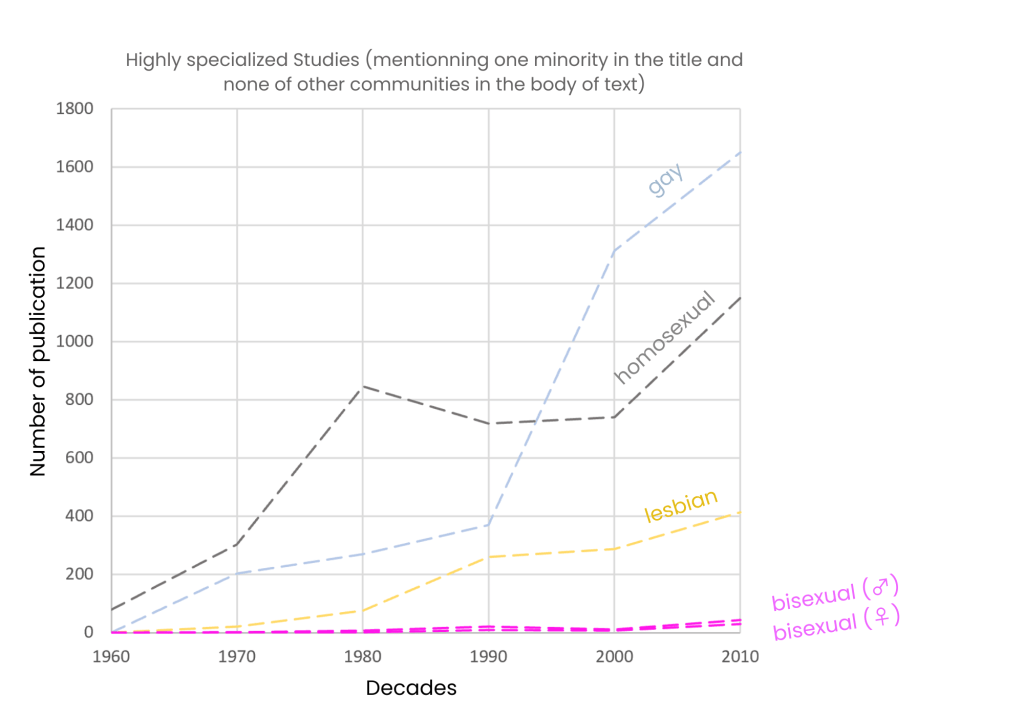
Figure 2: Highly Specialized Studies on Bisexuality from 1960–1969 to 2010–2019, Compared to Highly Specialized Studies on Gay Men, Homosexuals, and Lesbians. Highly specialized studies are defined as those that include the keyword in the title while excluding references to other sexual minorities in both the title and the body of the text. The research methodology and raw data are detailed in Appendix 1.
This underrepresentation is even more striking in highly specialized studies. As shown in Figure 2, between 2010 and 2019, there were more than 1,600 academic articles focused exclusively on gay men, with no mention of lesbians or bisexual people. In contrast, during the same period, there were approximately 400 specialized studies on lesbians and fewer than 30 on bisexual individuals.
The Compilation and Communication of Scientific Data: A Scientific and Activist Endeavor
The researchers and activists who have contributed to the quantification and dissemination of data on the effects of biphobia are numerous. However, the names remembered as influential in this field are often those of people who compile, summarize, or popularize the data. Unfortunately, there is far less symbolic recognition for work based on a single statistical study on biphobia. Among the major efforts in data communication and popularization, one can highlight the work of Julia Shaw (2022), whose book is the best-selling and most widely translated on the subject.
In France, the 2022 Biphobia and Panphobia Survey Report (Rapport d’enquête biphobie panphobie 2022), published by Act Up-Paris, Bi’Cause, MAG Jeunes LGBTQI+, and SOS homophobie, serves as a key national reference (Dilcrah 2022). On social media, both myself (Resa, 2021–2024) and Precarité Inclusive (2022–2023) have contributed to the popularization of quantitative scientific research on biphobia, reaching a certain level of visibility. In Belgium, the study conducted by Irène Zeiliger (2023) for the organization Garance is also widely recognized.
On the academic side, a number of review studies have focused on the heightened vulnerability of bisexual people in various areas, including: intimate partner violence (Bermea et al., 2018; Turell et al., 2018), suicide risk (Pompili et al., 2014; Salway et al., 2019), poverty (Ross et al., 2016), health outcomes (Feinstein & Dyar, 2017; Caseres et al., 2017), tobacco use (Shokoohi et al., 2021), addiction (Shultz et al., 2022), and premature mortality (McKetta et al., 2024), to name just a few of the most significant findings. All of these studies have helped demonstrate that bisexual individuals are more vulnerable than heterosexual, gay, or lesbian individuals.
However, this growing body of data still does not fully explain why or how biphobia is constructed. To address that question, another type of statistical research is needed, one that examines predictive factors and moderating effects.
A Preliminary Scientific Response: The Minority Stress Theory
Analyzing statistics can help identify what differentiates bisexual individuals who are doing relatively well from those who are more likely to experience suicidal ideation, poverty, or violence, for instance. While this type of analysis cannot definitively validate any one theory about the causes of biphobia, these predictive factors can nonetheless offer valuable insight.
At present, the dominant scientific consensus points to one factor that has consistently shown strong predictive power for the outcomes of bisexual individuals, and LGBT people more broadly: this factor is known as minority stress.
Minority stress refers to the chronic, everyday stress experienced by LGBT individuals due to their marginalized status. It comes on top of the general stress everyone faces. This specific stress is driven both by experiences of discrimination and by one’s own internalized perception of their sexual orientation or gender identity. Minority stress has been demonstrated as a predictive factor in a range of negative outcomes among LGBT populations, including cardiovascular disease, cognitive decline, mental health problems, and nicotine addiction (Li et al., 2024; Correro et al., 2020; Hoy-Ellis, 2023). Minority stress is also a key contributor to intimate partner violence experienced by bisexual women, among other issues (Bermea et al., 2018).
Yet a central question remains: Why do bisexual people experience higher levels of minority stress than gay men and lesbians? Here, the discussion re-enters the realm of theory and speculation. For many researchers, the explanation lies in the idea of double discrimination, that bisexual people face stigma from both broader society and from within LGBT communities themselves (ibid.).
I do not fully agree with any of these prevailing theories, neither Ochs’s view of biphobia as the product of accidental cultural bias within binary systems, nor Yoshino’s theory that it results from a social need to maintain binary classifications and monogamy, nor Eisner’s framework of monosexual privilege, nor even the theory of intensified minority stress due to compounded homophobia and biphobia. I do not believe these theories are wrong, but I do believe they fail to identify the original cause of biphobia.
In my view, these frameworks explain mechanisms that perpetuate biphobia, but not what created it in the first place. To understand the architecture of biphobia, we need a new theoretical framework, one that accounts for the complexity of bisexuality and its dimensions.
Part 2 – Toward a New Theoretical Framework for the Origin of Biphobia
To understand biphobia, one must first understand the fate of dual nationals in times of war. Like dual nationals, bi and pan individuals occupy an ambiguous position that, in moments of conflict, evokes mistrust and rejection. The “sin” of duality for bisexual people is only a sin because there is conflict. In times of peace, duality and fluidity pose no issue. This aversion to bisexual duality is the second cause of biphobia, but not the first. The primary condition for the emergence of biphobia is the attack of heterosexuality upon homosexuality. But first, let us examine the dynamics experienced by individuals who hold the nationality of both the aggressor and the attacked in times of armed conflict.
The Case of Dual Nationals in Wartime
Binational identity, often celebrated in peacetime for its diplomatic and cultural value, becomes a liability in times of war. These populations find themselves at the center of immense tensions, often perceived as potential traitors by both sides. In France, following the 2015 terrorist attacks, proposals were made to strip French citizenship from dual nationals convicted of terrorism, provoking national debates on loyalty and the stigmatization of dual nationals (Geisser, 2016). The oppression of dual nationals typically manifests in three major dynamics: suspicion of betrayal, forced assimilation, and exploitation.
Suspicion of betrayal can take the form of surveillance and control of binational and biethnic populations. After the 1941 attack on Pearl Harbor, approximately 120,000 people of Japanese descent living in the United States, many of them American citizens, were interned in camps on suspicion of loyalty to Japan (Robinson, 2012). When they are not surveilled or imprisoned, these populations are harassed or driven into exile, particularly when they live in the less powerful nation in a conflict. For example, after World War II, the Sudeten Germans, many of whom held both Czechoslovak and German nationalities, were perceived as traitors within Czechoslovakia. This community, present in Bohemia and Moravia since the 12th century, was subjected to brutal persecution beginning in 1945, including forced displacements under inhumane conditions. Between 1945 and 1947, three million people were expelled; tens of thousands, mostly women, children, and the elderly, died in the process (Brouland, 2017).
Dual nationals may also be viewed as infiltrators or privileged insiders within the oppressed nation. In the 1970s in Vietnam, the Hoa, an ethnically Chinese and Vietnamese minority, were subjected to defamatory campaigns and mass expropriations by the Vietnamese government due to rising tensions with China. China’s attempts to defend the Hoa only exacerbated suspicion. The persecution escalated to such a degree that it triggered a massive exodus. Fleeing in dangerous conditions aboard makeshift boats, these refugees became known as the “boat people” (in English in French culture) (Benoit, 2019). Whether they reside in the powerful aggressor state or in the attacked nation, dual nationals are systematically oppressed during and after wartime.
In addition to suspicion, dual nationals are often subjected to forced assimilation strategies intended to erase their dual cultural identity, for instance, by banning one of their native languages or reducing their cultural heritage to folkloric tokenism. In Canada, up until the late 20th century, Indigenous children were often placed in residential schools where their native languages were banned. These practices of assimilation and abuse have since been nationally acknowledged (Bousquet, 2012). The ethnic group known as the Métis, descended from both Indigenous and Canadian settler lineages, was especially affected. Many Métis children raised in Indigenous cultural environments were sent to residential schools, where they were marginalized both by school authorities and by Indigenous peers. They were also excluded from the first rounds of government compensation for residential school survivors (Logan, 2020).
As Belzile (2021) reported for Radio Canada, several high-profile cases of cultural appropriation involved individuals falsely claiming Métis identity to gain cultural or institutional capital, as shamans, artists, or academics. These revelations, alongside a growing number of people claiming Métis identity, have led to a climate of intensified suspicion. The Métis thus face a dual form of oppression: on one hand, cultural appropriation, and on the other, suspicion that their identity is fraudulent.
The oppression of homosexuality by heterosexuality is an ideological war, not a territorial or colonial one. Biphobia is not comparable in magnitude to the violence experienced by dual nationals in armed conflicts or colonization. Yet understanding the complexity of these situations, and particularly the role of oppression in shaping the conditions of binational targeting, helps us understand the structure of biphobia.
The Symbolic Dual Nationals of Lesbos
Today, the heterosexual superpower oppresses the insular and isolated lesbian “island.” Much like dual nationals during wartime, bisexual women face oppression and suspicion, regardless of their current relationship status. On the side of Heteroland, they are discouraged from building a life with women and grow up without positive representations of same-gender love. They are shamed and discriminated against if they live a lesbian life, or are merely suspected of doing so. Evidence of bisexuality being documented and pathologized still appears in psychiatric records, where a patient’s bisexuality is sometimes noted and associated with mental instability (Ross & Costa, 2021).
Bisexual women are exoticized and pressured to provide threesomes. They are staged and hypersexualized in narratives tailored to heterosexual erotica, particularly in mainstream pornography. When PornHub, one of the largest adult content platforms, declared “lesbian” as its most popular keyword, researchers found that many of those videos actually depicted bisexual scenes rather than exclusively lesbian ones (Bowling & Fritz, 2021). These researchers also identified that videos portraying exclusively lesbian scenes were more often targeted toward female audiences than bisexual scenes. Lesbian scenes were less likely to depict aggression and more likely to center on female pleasure and orgasm. In contrast, bisexual scenes featured fewer depictions of female orgasm and showed more frequent combinations of anal sex, fellatio, and vaginal penetration than either heterosexual or lesbian content. After analyzing over 1,000 pornographic films, the researchers concluded:
“We found significant differences in sexual behaviors and aggression among Heterosexual, Bisexual, and Lesbian categories of pornography. Bisexual scenes had higher frequencies of aggression and behaviors [e.g., fellatio, anal sex, vaginal penetration], except for depictions of female orgasms, than heterosexual and lesbian categories.” (Bowling & Fritz, 2021)
We can thus observe all the classic dynamics employed by powerful nations in the oppression of dual nationals during wartime: control, forced assimilation, exoticization, and cultural exploitation for the benefit of the oppressor.
Studies also show that the more homophobic a heterosexual person is, the more negative their attitude toward bisexual people, and the more likely they are to endorse harmful stereotypes. This aversion is even stronger than the one directed toward gay men or lesbians (Eliason, 1997; Nagoshi et al., 2023). This finding supports the homophobic origins of biphobia and helps distinguish it as a separate yet related form of oppression.
On the lesbian side, bisexual women are not always welcomed as sisters. Biphobia has been consistently documented within gay and lesbian communities (Friedman et al., 2014; Hertlein et al., 2016). Accusations of betrayal or privilege are common (Armstrong, 2014; Nelson, 2024). One emblematic case is that of Lani Ka’ahumanu in the United States, a bisexual woman who was excluded from lesbian spaces despite her long-standing activism (Rose, 2022). These instances mirror the suspicion directed at dual nationals even within oppressed nations.
I argue that this condition is not the result of a mere aversion to duality, but of the oppression of homosexuality by heterosexuality. Just as in wartime, only dual nationals belonging to both conflicting sides are targeted, not all dual nationals. For example, Irish-American dual citizens were not interned after the Pearl Harbor attack; Japanese Americans were. Likewise, in the LGBT community, “dual citizens” who are not suspected of having ties to heterosexuality are treated differently. For instance, asexual and homoromantic women, those who are not sexually attracted to anyone but are romantically attracted to women, are often accepted as lesbians. Within LGBT jargon, they are referred to as “Bambi lesbians” (Maskell, 2024), reflecting their perceived 100% lesbian status, despite lacking sexual attraction to women.
In contrast, bisexual women are not perceived as fully lesbian precisely because they are also attracted to men. In a world where heterosexuality had never violently oppressed lesbians, biphobia might never have emerged, neither in broader society nor within the lesbian community itself.
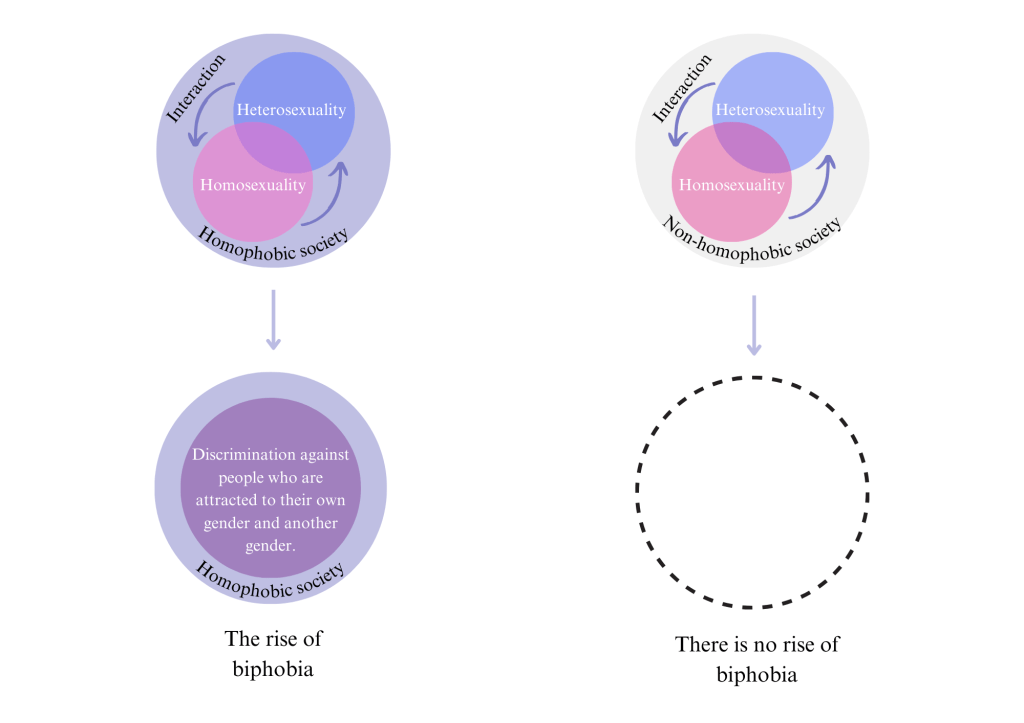
Figure 3 : Diagram of the Formation of Biphobia – A Homophobic Society as a Prerequisite for Biphobia
In conclusion, I am convinced that biphobia originates first and foremost from homophobia, and only secondarily from the bisexual interaction of heterosexuality and homosexuality. Its structure mirrors the architecture of wartime oppression against dual nationals (see Figure 3).
In political and theoretical discourse on biphobia, the idea that biphobia is driven by a need to uphold patriarchal order is widespread. This view is central to the theories of both Yoshino and Eisner. I do not believe this hypothesis is accurate. I argue that a patriarchal society that is not homophobic does not give rise to biphobia. I will illustrate this point by examining the situation in Tahiti, in French Polynesia.
Case Study: The Tahitian Context
Tahiti, despite its idealized image, experiences high levels of domestic and gender-based violence (Cerf, 2007). Even prior to Western colonization, the culture was marked by structurally sexist norms. Women were considered religiously impure, and the island operated under a patriarchal hierarchy that penalized women from lower classes. In the more inhospitable island regions, women were enslaved, and infanticide of female babies was practiced (Langevin-Duval, 1979).
And yet, Tahitian society has long accepted as natural same-gender relationships, masculine women, and feminine men. I was first introduced to this reality through conversations with a Tahitian woman I will refer to as Tatiana. In informal discussions, I learned that three members of her family were part of sexual or gender minorities, without it being a source of conflict. In her words, she had a “feminine uncle, raerae”, her husband’s mother lived with a woman, and her cousin had had both male and female partners throughout her life.
When I asked whether people made fun of her effeminate uncle, whom she often mentioned, she said that French people and foreigners did, but only because “they don’t understand the raerae.” She added, “Here in Tahiti, it’s natural. It’s always been like this.” She struggled to explain what the raerae were, describing their graceful gestures, feminine clothing, and mannerisms. When I asked if raerae were gay men, she said no, her uncle was married to a woman. I also asked about masculine women, lesbians, and transmasculine individuals. She brushed the question aside, saying: “It’s the same thing. They’re raerae.”
This exchange was my first introduction to the topic. I had to do further research to better understand who the raerae were and how homophobia manifested, or didn’t, within Tahitian society.
Tahiti is an example of a sexist but not culturally homophobic society. It is often described as a “paradise for LGBT tourists.” A business article by Masters (2023), aimed at queer travelers and promoters, notes that there are no gay bars in Tahiti because all bars welcome all kinds of people to celebrate together. Homophobia and transphobia in Tahiti are largely imported from Europe, particularly via Christianization and French institutions such as schools and police. This was confirmed by the local LGBT association Cousin-Cousines in interviews with the press (Martinez, 2023; MG, 2023).
To better understand the situation, I spoke with an activist from the association. She explained that LGBT teens are mostly kicked out of their homes for religious reasons, particularly in Christian families, and that the more religious the environment, the more abuse occurs. Westernization has increased the difficulties sexual minorities face within their families and heightened experiences of violence. Still, Campet (2009) observes significant tolerance in the Tahitian communities she studied, especially toward local sexual and gender minorities.
There is, furthermore, a clear distinction between Western conceptualizations of homosexuality and the pre-colonial social structures of the islands. The terms raerae and mahu describe different types of gender and sexual minorities, with raerae being the more recent term. This difference became politically contentious during the debates around France’s same-sex marriage legislation. At the time, a Polynesian deputy opposing the law declared: “In French Polynesia, we don’t have the same kind of homosexuals as in mainland France. We have our raerae, we have our mahu, but they are not the same homosexuals.”
The situation is far from ideal for LGBT people, but culturally, it is clear that male dominance over women has not translated into a specifically Tahitian form of homophobia or transphobia. So what about biphobia in this context?
According to the theories of Yoshino and Eisner, biphobia should arise in order to reinforce patriarchal norms. And yet, in Tahiti, this is not the case.
Can a Patriarchal but Non-Homophobic Society Be Biphobic?
Tahiti has more deeply rooted sexist norms than many Western societies, but it is also lesshomophobic. If my theory is correct, then biphobia should be more present in the most Westernized, and thus more homophobic, sectors of Tahitian society. Conversely, if the theories of Yoshino and Eisner are accurate, biphobia should be most visible in the least Westernized, and therefore most patriarchal, sectors of society.
Evaluating biphobia or the place of bisexuality in Tahiti is complicated by the fact that bisexuality is a Western concept. Thus, speaking about biphobia in the Tahitian context is not straightforward. However, what we can examine is the place of sexual and gender fluidity within Tahitian society.
The mahu, individuals assigned male at birth who take on female roles and have sexual relationships with men, are an example of socially integrated gender fluidity. A mahu may later stop identifying as such, marry a woman, and have children (Campet, 2002). Temporal fluidity is therefore tolerated within this social category. A similar flexibility exists for women. Tahitian anthropologist Natea Montillier Tetuanui describes what she refers to as female raerae in these terms:
“A female raerae behaves and sees herself almost as a man, dresses like a man, but still uses the women’s restroom. She may adopt children from within the family. At home, she participates in both women’s and men’s activities, such as cooking, woodworking, and fishing. She chooses her profession based on her skills, whether it is a traditionally male or female role. A young woman might try dating a man, then go on to settle down with a woman. One of the two women tends to remain more feminine.” (Montillier Tetuanui, 2013)
These raerae women can transition from heterosexual relationships to long-term same-gender relationships without losing their social identity. Moreover, they can freely move between gender-coded activities without being stripped of their raerae status. For many Western observers, the raerae category is mistakenly conflated with sexual orientation, but it is more accurately a gender identity than a label for sexual preference. As Campet (2002) explains, raerae assigned male at birth may engage in same-gender relationships, but that does not make them mahu. Here again, fluidity and duality are accepted within the very category of raerae.
However, this nuance is often erased in Western anthropological literature. Several academic sources portray the raerae exclusively as men who have sex with men. For instance, Stip (2015) defines raerae as a category assigned male at birth and discusses only their male lovers. Lacombe (2008) goes so far as to deny that raerae may have sex with anyone other than men, stating:
“While raerae do not consider themselves homosexuals, the majority, if not the entirety, of them maintain sexual relationships with men, whether those men are aware of their singular condition or not.”
It is also remarkably difficult to find anthropological sources discussing raerae assigned female at birth. Aside from my conversation with Tatiana and the work of Montillier Tetuanui, I found no sources addressing raerae as women.
By presenting raerae exclusively as homosexual men, Western anthropologists project a binary framework that erases large segments of raerae identity. All available evidence suggests not only that raerae are not perceived as “homosexuals” (probably because those assigned male at birth are not perceived as men), but also that their sexuality is not exclusively directed toward men. If there is a binary at play, it exists in the eyes of the Western ethnographer. Thus, in its traditional, less Westernized forms, Tahitian culture embraces relational and gender fluidity, for both individuals assigned male and female at birth.
In my personal interactions, I noted that Tatiana, the Tahitian woman I spoke with, mentioned her cousin’s bisexuality without judgment. She also responded very positively when I came out as bisexual. I had never experienced such a smooth and easy coming out. When I mentioned my divorce from my ex-husband and my breakup with my ex-girlfriend, she asked no intrusive questions, showed no surprise, and simply expressed concern for the emotional toll of my most recent breakup, the one with my female partner. I must stress how unique this experience was. Never in my life had I mentioned my bisexuality without it triggering either hostility, awkward questions, discomfort, or, at best, a performative show of support.
For Tatiana, my bisexuality both existed and didn’t exist. She registered the information, but it required no special response. She simply hoped I would heal from my heartbreak and find love again. Her attitude toward me didn’t change. She had liked me before knowing I had been married to a man for fifteen years and had recently been in a relationship with a woman for a year and a half, and she continued to treat me with the same warmth and friendliness afterward.
Tatiana had the following profile: a woman without higher education, owner of her inherited home in Tahiti, employed in the tourism industry. She wore traditional tattoos, a flower in her hair daily, spoke fluent Tahitian, had danced professionally in traditional settings, and had allowed her underage son to get a tattoo of a turtle and flower before the age of fifteen, practices very different from Western norms. She used TikTok, had stopped attending church for several years, and spoke fluent French. She had temporarily moved to mainland France with her family to work and save money. She had also experienced serious domestic violence in a prior relationship. Tatiana straddled both Western and traditional Tahitian cultural spheres. Her attitude toward my bisexuality aligned clearly with the more traditional, less Westernized aspects of her background.
Altogether, there is a body of evidence suggesting low levels of biphobia and strong acceptance of sexual and gender fluidity in highly Tahitian and minimally Christianized cultural contexts in Tahiti.
What about the more Westernized and homophobic sectors of Tahitian society?
Biphobia in Contexts Affected by Homophobia
To better understand the situation, I spoke with a South American activist who had settled in Polynesia, we will call her Ofelia. She had grown up in a country marked by terrorism and military coups and described a clandestine LGBT environment, including police raids on bars frequented by queer people. When leftist activists began to disappear, she and her friends fled, and she eventually resettled in Polynesia.
Ofelia identifies as pansexual, was married to a man, has children, and has been active in LGBT rights advocacy in Tahiti. Like the activists from the association Cousin-Cousine, she described extreme violence faced by gay, bi, and lesbian adolescents in the most religious Christian families, and explicitly identified Christian churches in Tahiti as the primary source of homophobia and related social problems.
She described the activist landscape as follows: in Tahiti, there is only one LGBT association, with a well-followed Facebook page but few dues-paying members. Of those, only a small number are active participants in meetings or events, which makes it difficult to speak for the entire community. There are also informal groups on Facebook: dating groups, mostly for men, and two women’s groups, one public, intended for women who love women, whether residents or travelers; and another, a private circle of mostly lesbian friends who organize activities together.
The broader LGBT community includes residents of European descent, demis (people of mixed European and Polynesian heritage), and a few Polynesians, often those from more Westernized backgrounds. People more rooted in traditional Tahitian culture generally avoid LGBT associations, preferring to participate in cultural organizations. Interestingly, many local artists are gay or bisexual.
Regarding bisexuals, they are, in principle, fully included in LGBT spaces and associations. However, a certain suspicion remains. Many believe that a bi person, whether in a heterosexual or homosexual relationship, will eventually seek out the other gender to achieve some notion of « completion. » Ofelia, who identifies as pansexual, does not share this biphobic view. She also noted a double standard in LGBT spaces: those with a heterosexual past but currently in same-sex relationships are well accepted, whereas those currently in heterosexual relationships but with a same-sex past are often less welcomed.
She also offered insights into how Tahitians perceive bisexuality. According to her, bisexuality is not really seen as a concept in Tahiti. Instead, people observe behaviors: men occasionally engaging with effeminate partners; women experimenting with other women; individuals attracted to both genders but not openly labeling it. Generally, she explained, bisexuality is less understood than trans identity, which has clearer cultural references and is better integrated due to its alignment with traditional gender codes.
Her account supports the idea that biphobia is present within the LGBT community, a space that is itself highly Westernized and shaped by Christian homophobia. Rejection of bisexuality within Christian communities mirrors the rejection of homosexuality.
If the maintenance of patriarchy were the root cause of biphobia, then Tahitian culture would not tolerate the kind of relational fluidity it clearly does. Nor is it about a cultural need for rigid categorization: Tahitian society has effectively categorized fluidity through concepts like raerae, without societal disruption, and even allows for movement in and out of the more binary mahu category. In contrast, the LGBT community, made up largely of survivors of Christian violence and shaped by Western norms, displays a familiar pattern of biphobia, exactly as my theory predicted.
Understanding homophobia as the foundational condition for biphobia not only better predicts where biphobia will arise, but also offers clearer insight into the internal dynamics of the bisexual community. For example, it helps us understand why bisexual men are often treated like gay men, while bisexual women are treated like heterosexual women…
The Homophobic Origins of Biphobia: The Case of Invisibility
Biphobia targeting women and biphobia targeting men share similarities, but they are not entirely identical. In Eisner’s framework, patriarchy and sexism are the primary forces behind biphobia, shaping the distinct ways bisexual men and women are treated. She develops this argument by pointing to what she calls phallocentric adoration as the root of the differing forms of invisibility experienced by bi men and bi women. She writes:
“(…) bisexual women are actually straight, while bisexual men are actually gay. The idea presented here is that of the immaculate phallus, suggesting that phallic adoration is the one true thing uniting all bisexual people. It projects society’s own phallocentrism onto the idea of bisexuality. This permits us to critically reflect this phallocentrism back into society, exposing the underlying system of sexism and misogyny as we do so.” (Eisner, 2013)
Eisner’s thinking is deeply influenced by the text “Phallocentrism and Bisexual Invisibility” by Michael Rosario, which she cites in her book. Rosario writes:
“It is very easy to receive the gay membership card if you’re a boy. You touch a cock, and that’s it. You’re gay. Forever. … To be honest, I didn’t even have to touch a cock to get it. Before I touched one, all I had to do was to say, hey, I wouldn’t mind touching one. … From that very moment nobody ever disputed that I could be gay[,] [though] [i]t’s certainly disputed that I’m bisexual…. I could never be heterosexual. Not that I’d want to, but even if I wanted to, I couldn’t. I’ve hooked up with boys and that disqualifies me. … If I request the heterosexual membership card I get the application returned with the stamp: DENIED. REASON: COCKSUCKER. … And I constantly have to … request the bisexual membership card by special delivery, only to have my application returned to me …” (Eisner, 2013)
Thus, Eisner sees the invisibility of bisexual men as a function of sexist and phallocentric mechanisms. According to her, the “contaminating” effect of male homosexuality stems from society’s symbolic obsession with the penis. But it is not adoration of the penis that “contaminates.” It is not because fellatio is valued that gay and bisexual men are labeled as gay. On the contrary, being a “cock-sucker” is heavily stigmatized, and that stigma has a name: homophobia.
Failing to understand the architecture of biphobia leads to frameworks that appear logical but overlook lived reality. In this case, for example, ignoring the evident homophobia that bisexual and gay men experience in relation to this idea of contamination distorts the analysis.
My critique of Yoshino and Eisner’s theories is that they portray sexism as the parent of biphobia, when it is, at best, its grandparent. The true parent of biphobia is the stigma surrounding homosexuality. I do not believe that bi men are perceived as gay, and bi women as straight, because society supposedly values only sex with men or worships the erect penis. The key difference in how bisexual men and women are treated lies in the homophobic foundation of biphobia.
Male homosexuality is perceived as contaminating in a way that lesbianism is not, because lesbophobia follows different logics than the oppression directed at gay men. For this reason, I will now take the opposite approach to Eisner: I will not focus solely on sexism, but instead examine the stigma against gay men, and then against lesbians, as the more accurate way to understand this divide.
Can homophobia better explain the differing treatment of bisexual men and women?
Homophobia
To better understand how male homosexuality is treated, let us look at the example of ancient Greece and Rome. These societies are often portrayed as politically bisexual systems, where being bi was considered the norm. However, in truth, free men and citizens were not permitted to be bisexual in the modern sense. Men of high social status were patriarchs who had the right to penetrate women, as well as slaves, male sex workers in Rome, and adolescent boys in Greece (Lear 2013; Verstraete 1980). Sexual relations between two adult men of equal social status were deeply frowned upon and heavily stigmatized (Worthen 2016). In these societies, sexuality and penetration were tools of domination.
I am not saying that every penetrative act is an act of domination. But it is an act of domination when it is used to assert power or humiliate the other person. It is domination when there is no consent. When it involves the uncompensated sexual service of one body for another. When it is mandatory or prioritized. When it consists of masturbating one’s own genitals inside another person. Pardon my French.
Penetration is not an act of domination when all the conditions of equality are met: when the penetrated person is equal in rights, value, and social consideration to the person penetrating; when there is active, enthusiastic consent; when both parties mutually exchange sexual services in a reciprocal and egalitarian way; when penetration is optional and secondary; and when it is done primarily for the pleasure of the person being penetrated.
Let’s note that if the pleasure of the person being penetrated were truly prioritized, straight men would use sex toys more often. Sex toys are known to bring significant pleasure with minimal effort. However, they provide neither social status nor erogenous stimulation for the penetrating partner, perhaps one reason why they are so underused in heterosexual encounters.
To be clear, penetration is not inherently dominating when it occurs:
- between equals,
- with consent,
- as an optional act,
- and when it is for the pleasure of the person penetrated.
Ultimately, even a trashy, balls-clapping doggy style session[1] can be totally egalitarian in traditional monogamous straight relationship, if and only if all of the following conditions are met, with the first being the most critical:
[1] You have no idea how much gets lost in the English translation. Since I know how much Americans love my native language, I should clarify that the original term was levrette claquée, not ‘balls-clapping doggy style.’ It means exactly the same thing, but it definitely sounds better in French. Yes, we have a word for that. And I think it’s beautiful. It’s pronounced luh-VRETT klah-KAY. You are welcome.
- He has signed a marriage contract that guarantees dignified post-divorce living conditions for her;
- She doesn’t have to sacrifice her career for his;
- He won’t leave her for someone younger;
- He tracks his contribution to household chores on a spreadsheet;
- He supports her mental health and provides stability;
- He is equally competent and committed to her pleasure as she is to his;
- He stands up for her against the minimization of her skills and intellect;
- He publicly challenges rape jokes and the degradation of female sexuality;
- She has expressed overflowing and continued enthusiasm for said levrette claquée;
- She has other options than that sexual act;
- And finally, the levrette claquée is open to both genders.
Too often, men who consider themselves « woke » focus on prostate play and female orgasm while continuing to ruin the mental and financial health of the women they take from behind. That is not what I call egalitarian doggy style.
I include this aside for readers who might be disturbed by the association I make between penetration and domination. If that association exists in society, it is entirely possible to redefine it in individual relationships. However, I am not speaking here of individual relationships, but of societal structures, and within both modern and ancient societies, penetration has indeed been used as a tool of dominance.
Thus, ancient Greece and Rome were not bisexual or even homosexual systems, but rather variants of modern heterosexual patriarchy. Sexual dominance was exercised over the “other gender”, meaning anyone who was not a high-status adult male. Dominant men were strictly forbidden from being passive or penetrated in their sexual practices.
Australian sociologist Raewyn Connell, who pioneered academic research on masculinities, defines hegemonic masculinity as the dominant model, and identifies subordinate, complicit, and marginalized masculinities as subjected to it. Men marginalized by race, class, or disability fall under what she calls marginalized masculinities. According to Connell, the dominant man exerts power over other men, and particularly over gay and bisexual men, whose identities are categorized under subordinate masculinities.
She describes homophobia as co-constructed with heterosexuality, stating:
“Heterosexual masculinity did not predate homophobia but was historically produced along with it.” (Connell, 1992)
According to Connell, heterosexual masculinity is built not only through the domination of women, but also through the exclusion of gay and bisexual men from the ranks of the dominant. Male homosexuality is thus stigmatized because it removes a man from his superior position and places him in a subordinate masculinity. Because penetration is symbolically charged in this system, gay men perceived as passive are particularly devalued. The virile, active gay man is less stigmatized than the femme, the sissy, or the bottom (Taywaditep, 2002; Wang, 2025). However, it is important not to assume that only passive gay men are discriminated against, male homosexuality as a whole remains subordinate to hegemonic masculinity.
As a result, homophobia directed at men is « contaminating ». But it is not the contact with a penis that contaminates, it is the contact with submission. The masculinity embodied by homosexuality is subordinate to that of the dominant heterosexual man, and that is what contaminates.
Thus, proximity to homosexuality for men, and to heterosexuality for women, defines their subordinated rank. A single contact that signals submission is enough to mark someone as subject to the authority of dominant men. This “contaminating submission” has profoundly shaped the difference between homophobia targeting gay men and lesbophobia.
Lesbians are perceived as escaping male domination. In patriarchy, they must be brought back into line, as they have rejected heterosexuality. Gay men, on the other hand, must be ostracized, as they have betrayed their rank. Lesbianism must be tamed; being gay merits exclusion.
From the perspective of systemic force:
- Homophobia targeting gay men is centrifugal (pushing from the center to the periphery);
- Homophobia targeting lesbians is centripetal (pulling from the margins toward the center).
(See Figure 4.)
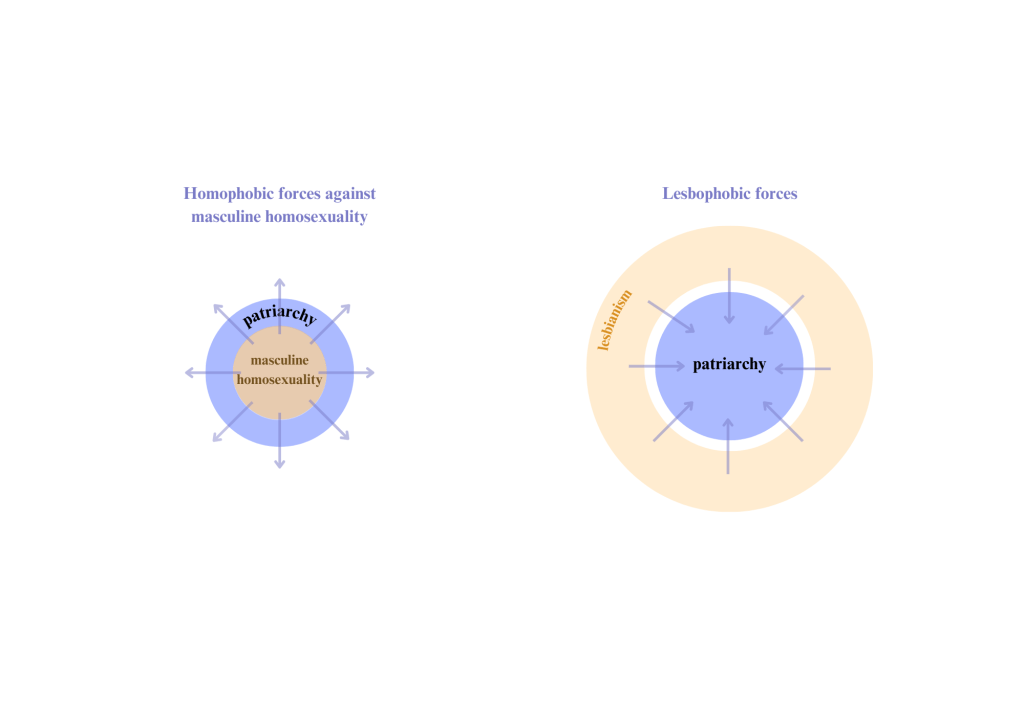
Figure 4: Diagram of the Different Forces of Homophobia Depending on Whether They Target Male or Female Homosexuality.
The Difference Between Bi People on the Lesbian Spectrum and Bi People on the Gay Spectrum
The forms of biphobia experienced by women and men are not exactly the same, because gays and lesbians are not treated in the same way. The part of bisexuality perceived as deviant, homosexuality, is not subject to the same oppressive forces depending on whether it is expressed in men or women. This has shaped how biphobia has evolved on a broader scale: it mutates, adapts, and responds to its environment and to different normative pressures.
Bi women are perceived as straight, and bi men as gay, because both are understood in terms of their submission to hegemonic masculinity.
One might argue that, in the end, sexism is still the root force at play. My goal is not to deny the role that sexism plays in biphobia, only to emphasize that its role is secondary. When people claim that bisexual discrimination stems solely from patriarchy, they consistently erase the role of homophobia. This erasure is especially visible in Eisner’s argument on phallocentrism. When a bi man says, essentially, “I’m not considered bi because I sucked a dick,” Eisner fails to identify this as a clear manifestation of homophobia, instead theorizing around the idea of an “immaculate phallus.”
My aim is not at all to deny the theoretical contributions of those who came before me, but rather to bring homophobia back into the picture, to relegate marginal influences to the margins, and to formulate a clear and direct equation of biphobia, one that doesn’t rely on indirect forces alone.
According to Yoshino and Eisner, homophobia is itself derived from patriarchy, which implies that biphobia and homophobia are on the same structural level. In their framework, sexism is the primary oppression, while both homophobia and biphobia are secondary oppressions. Perhaps for some, this hierarchy elevates bisexual discrimination to the same « evolutionary tier » as homophobia against gays and lesbians, making it feel more serious or legitimate.
But I do not believe these oppressions are structurally identical. However, in arguing that biphobia stems from homophobia, I am not claiming it is less serious, or that bi people are somehow subordinate to homosexual people. What I am claiming is that the architecture of biphobia is more complex.
That said, I am not equating biphobia with homophobia. Just as I am not the same person as my parents, biphobia is not the same oppression as homophobia. I also do not believe that oppressions should be ranked by their degree of complexity. My focus is simply to theorize biphobia, in the hope that we can fight the violence bisexual people face more effectively if we understand it better.
What Are the Consequences of Failing to Recognize the Homophobic Roots of Biphobia?
Misunderstanding the architecture of bi oppression leads to discourse and actions that are ineffective. The further a narrative strays from reality to uphold a theory that doesn’t hold up, the less it can offer concrete applications for bisexual people.
Let’s imagine, for example, a bisexual advocacy group trying to launch a public awareness campaign focused on the experiences of bisexual men. They explore two proposals. The first is based on Eisner’s theory, which suggests that bisexual men are oppressed through phallocentrism and society’s worship of the erect penis. The second campaign is based on an analysis that identifies homophobia as the root of biphobia, and emphasizes the distinction between the two.
So the organization must choose between:
Option 1 – Fighting phallocentrism:
- “Stop worshipping dicks.”
Option 2 – Addressing homophobia and biphobia separately:
- “Men who go down on other men? That’s okay.”
- “Some men are into both guys and girls. That’s called bisexuality, and that’s okay too.”
Option 2 may be less exciting from a theoretical standpoint, but it’s more anchored in lived experience. It’s also more complex, because it involves two layers of messaging, but it better reflects the reality of biphobia. I believe it is crucial that we recognize when we’ve made a misstep, and that we remain capable of evolving in order to better serve the bi and pan communities.
From this point on, I will primarily focus on biphobia directed at women and people perceived as such. I will concentrate specifically on the lesbian spectrum of bisexuality. As a result, I encourage bi and pan men to take ownership of the concepts that concern them, and to develop a masculine bisexual theory that addresses bisexuality on the gay spectrum.
I’m fully aware that the bisexual community today is primarily organized and theorized by women, and that bi men are still in the minority for now. I also acknowledge that there are bi and pan individuals who move fluidly between gay and lesbian communities, who transition, and/or who are non-binary, and whose relationship to gender and sexuality is more complex. I invite those individuals, too, to contribute to a bisexual theoretical framework that reflects the broad diversity of bi and pan experience.
To return to the central thesis: Biphobia was born from homophobia. But these are distinct forms of oppression. So, what exactly is the difference between them, and how do they impact bisexual women?
Part 3 – Biphobia and Lesbophobia: Two Distinct Forms of Oppression
In my activism, I have often heard the argument that bisexual women may experience homophobia, but only when they are in a relationship with another woman, and that biphobia simply doesn’t exist. This belief is so deeply rooted that one of the key slogans of the French association Bi’Cause, chanted during the 2022 Bi Visibility March in Paris, was:
“Bisexuality exists, and so does biphobia.”
I can still hear the voice of Vi-vi, a member of the oldest bi and pan association in France, repeating that phrase over and over through a megaphone.
“La bisexualité existe, la biphobie aussi.”
The belief that biphobia doesn’t exist remains a serious issue to this day.
Yet I cannot speak about biphobia without first addressing the lesbophobia that bisexual women face. Because more often than not, the same people who deny the existence of biphobia also deny the reality of homophobia experienced by bi women.
Denial of the Homophobia Experienced by Bi Women in Heterosexual Relationships
There is a dominant narrative that denies the existence of lesbophobic oppression experienced by bisexual women who are single or in heterosexual relationships. This discourse is also present within the bisexual community itself, and many bisexual people actively uphold it. This belief is not necessarily ill-intentioned, it can be expressed in subtle or even caring ways.
For example, a former lesbian partner once told me that she often felt guilty for exposing me to lesbophobia simply by loving me. I found this statement particularly striking. She was not my first female partner, for one thing. But more importantly, I was puzzled by the power dynamic implied in her words. In her view, it was her love that brought me into the realm of lesbophobic oppression. I doubt she would have said the same about my love exposing her to oppression. And yet, I was the one who had made the first move in our relationship.
She still felt responsible for the lesbophobia I experienced, because she loved me. This confession revealed a deeper belief: that bi women are not exposed to lesbophobia outside of their relationships with women. The first way this homophobia is denied, then, is by reducing it to something that only occurs within lesbian couples, and not outside of them.
And yet, a bisexual woman was once a little girl, raised on stories about princes charming princesses, but never princesses charming each other. Like lesbians, bisexual girls grow up in a society that erases the possibility that they might one day love women. When they become teenagers and adults, their same-gender desire is mocked, punished, and degraded.
Loving women doesn’t just have consequences when it’s mutual. Growing up in a world that hates the idea of women loving women is profoundly violent for those affected by it.
So let me be clear: bisexual women experience the effects of lesbophobia long before they know they are attracted to women, and long before they ever enter into a relationship with one. Even if she remained single her entire life, a lesbian would still experience lesbophobia and suffer from it. She would live in a world that erases her community and shames her for who she is. That would undoubtedly affect her sense of self and her well-being.
Likewise, even if she stays single or in heterosexual relationships her whole life, a bi or pan woman is also affected by lesbophobia, and she suffers from it too.
And this denial of the homophobia experienced by bisexual women continues even when they are in relationships with women.
Minimization of the Homophobia Experienced by Bi Women in Lesbian Relationships
Bisexual women are often confronted with a strange double standard. On one hand, they are told they do not face lesbophobia if they are single or in a heterosexual relationship. On the other hand, they are told they don’t truly experience lesbophobia even when they’re in a relationship with another woman. I’ve heard this second claim far too many times, often in subtle or indirect forms. In fact, the argument that biphobia doesn’t exist is often paired with a persistent, irrational idea: that bisexual women are somehow magically protected from lesbophobia.
Let me take the time to outline a few indirect ways in which the lesbophobia experienced by bi women in lesbian relationships is invalidated.
The first way is to exclude bisexual women from reclaiming stigmatized terms used to resist lesbophobic oppression.
On the internet, for instance, I have repeatedly been told not to use the word “gouine” (a reclaimed French dyke slur), supposedly because as a bi woman, I do not experience that form of oppression. I had used the term in a neutral, contextual way, referring to the differences between gouine (more underground) and lesbian (more institutional) cultures. My lesbian relationships were known to those involved in the discussion. Still, hostile commenters seemed to believe that this word could only be spoken by pure-blooded lesbians, as though my bisexuality protected me from the stigma that weighs on lesbian love.
But my bisexuality did not protect me from being hypervigilant in public spaces with every woman I ever dated. It did not stop a man from asking if I « licked my girl good at night » while trying to grope me and my partner. It didn’t stop that drunk guy from grabbing me and trying to kiss me by force to “tease my girlfriend.” It didn’t stop him from shouting “and don’t forget to f* real good” at us when we ran into him again. My bisexuality didn’t stop a harasser from calling me a “gouine” and a “pussy-eater.”
If being called a gouine makes one a gouine, then I am one, and so are many bisexual women.
The second way this oppression is minimized is more systematic and insidious: it’s done by downplaying the impact of lesbophobia during the relationship itself.
The same woman who once said her love for me exposed me to lesbophobia also claimed that, despite our relationship being public and official, I wasn’t really facing the same level of lesbophobia that she did as a lesbian, because we didn’t live together. Never mind that we had traveled to Spain so she could meet my family. That I had spoken of her and shown pictures of us to all my friends. That I had invited her to my workplace for a public event, and brought her to my colleague’s year-end gala. Apparently, because we didn’t share a home, that changed everything.
Strangely, she didn’t apply the same logic to herself, that not living with me meant she didn’t face lesbophobia either. When I pointed out how absurd that argument was, she doubled down. She told me that in any case, we would never go through IVF together, so I would never know what real lesbophobia was. According to her, as a bisexual woman, if I didn’t tick every box, living together, legal partnership, parenthood, I wasn’t entitled to claim victimhood. She, as a lesbian, had that right by birth.
This kind of hierarchization of lesbophobia, which my ex used to discredit my experience, is one of the mechanisms used to exclude bi women from lesbian solidarity. Lesbians are never subjected to this kind of gatekeeping. I’ve never heard anyone tell a lesbian that unless she goes through IVF, the lesbophobia she experiences isn’t legitimate. It is only bi women who are routinely placed on a spectrum of lesbianism, and who are forced to prove they’re oppressed enough to be taken seriously.
The Hierarchization of Lesbian Experience: A Tool of Biphobia
I’ve read and heard countless arguments along the same lines, arguments that place bisexual women within a logic of minimizing their homosexuality. One woman « wasn’t really queer » because she had never been in a serious relationship with a woman lasting more than six months… because her genitals had never been penetrated or licked by a woman… because she had never deep-kissed a woman, « just a peck, » so it didn’t count.
Clementine Morrigan, a bisexual Canadian writer, shares in an essay on betrayal how her first girlfriend, a teenage relationship, later described her as straight, disqualifying both their relationship and their sexual intimacy, because they had only orgasmed through grinding. That ex-girlfriend not only decided Morrigan wasn’t queer, but went out of her way to convince others of this years later (Morrigan, 2024).
Maybe you’re thinking there’s some threshold beyond which it becomes acceptable to deny a bisexual woman’s homosexuality and the lesbophobia she faces. Perhaps it would be too much to say I didn’t experience lesbophobia just because I didn’t go through IVF, but the woman who’s never deep-kissed another woman? That’s a different story…
But I don’t believe there’s any acceptable threshold for denying the very real lesbophobia bisexual women experience, or the homosexual nature of their desires and relationships. The moment a woman has felt « deviant » desire for another woman, she becomes vulnerable to lesbophobia.
I fully acknowledge that there’s a wide spectrum, from the terror of a first unfulfilled same-gender crush to the trauma of surviving a lesbophobic sexual assault in public. I’ve experienced both. But I also know that the gradient we’re forced into always aims to delegitimize bi women. This hierarchy is rarely about recognizing the severity of the most violent attacks. Those who insist on ranking us on a scale of victimhood have no real idea what the « least exposed » bisexuals live through, and always underestimate what the most exposed endure.
And a victim who is not recognized is a victim who is not defended. Victimhood is not a badge of honor, it’s the basis for collective defense. When that drunk man tried to kiss me by force, two women stepped in: my girlfriend, and a visibly queer waitress. She didn’t stop to ask whether I was bisexual or lesbian before stepping up. She simply recognized that I was experiencing a lesbophobic sexual assault in public, and acted out of solidarity.
But collective defense doesn’t end at stepping in during an assault, it also means supporting victims afterward. Being exposed to lesbophobic violence, only to be told afterward that “only real lesbians experience lesbophobia,” adds another layer of harm.
The secondary trauma of not being believed when speaking about the violence we’ve experienced is far from trivial.
Doesn’t the slogan “We believe victims” apply to bi women who are victims of lesbophobia too?
I would like to invite lesbians to try the following thought experiment:
Imagine you’re in a relationship with another woman. One day online, during a conversation about lesbian culture, strangers order you not to say the word « dyke, » because it’s a reclaimed slur reserved for real victims of lesbophobia. Your own partner tells you that you’re not a real victim because you haven’t gone through IVF, neither has she, but that’s different. People start interrogating your sex life, asking whether your vulva has actually been licked or fingered by a woman, or whether you actually kiss with tongue. Your high school girlfriend tells mutual friends: “Oh, I know her. She says she likes women, but really, she only likes straight stuff, like dry humping.” You’re asked how long your longest relationship was, and no matter the number, you’re told it’s not really serious. People say you’re just here for the fun part.
Please, actually try this thought experiment. How would it feel to go through all of that?
The injustice that bisexual women face isn’t just being excluded from lesbian solidarity when they’re in same-gender relationships. It’s also knowing in advance that this solidarity will be denied to them at every step of their journey into their own homosexuality.
I’ve had more relationships with women than with men in my life. And yet, before I ever dated a woman, I already knew I would never be seen as a real lesbian, and that I was alone in the face of lesbophobia. Many bisexual women have told me they are afraid to even try, afraid to approach the community, because of all the stories of rejection and suspicion they’ve heard.
There is no stage of sexual development at which minimizing lesbophobia is harmless.
Wanting the lesbophobia we experience to be acknowledged is important, because that recognition is what extends the group’s protection to our community. It reduces our isolation.
Bisexual women, therefore, experience the consequences of lesbophobia, not indirectly, not only when they are in a relationship with another woman. They are subjected to it from childhood, and they are exposed to it in their relationships with women.
Recognizing this is a key step toward understanding how the oppressive system targeting them actually works.
But what about biphobia itself? What makes it different from homophobia?
Confusion and Ambiguity Between Homophobia and Biphobia
I often feel that many bisexual people, and their allies, with the best of intentions, use the terms “bisexuality” and “biphobia” as synonyms for “homosexuality” and “homophobia.” For example, in a lesbian couple composed of a lesbian and a bisexual woman, I’ve seen people describe the relationship as “bisexual” out of respect for the bi partner. Similarly, the homophobia experienced by bisexual women is sometimes referred to as biphobia.
This kind of language is most often used by people trying to show support for the bi community. They don’t explicitly say they are using the terms interchangeably, but that’s what ends up happening.
Using the word “biphobia” as a substitute for homophobia is often meant to be a positive gesture. In a world where bisexuality is heavily erased, simply saying the word “bi” often becomes a way of saying “I see you.” Well-intentioned people want to believe bi people. Bi people say biphobia exists; these same allies choose to believe them on principle, even if they don’t quite understand what biphobia actually is.
So biphobia gets boiled down to “hatred of bi people.” But most often, what people picture is hatred of their homosexual side, which is, in fact, hatred of homosexuality, or homophobia.
Sometimes, this ends up being more of a surface-level show of support: people are willing to use the term “biphobia” to refer to the homophobia experienced by bi women, but not to the point of supporting bisexual autonomy or bi-led organizing. In fact, one of the few people who openly told me they used “biphobia” and “homophobia” interchangeably did so to argue against funding bisexual activism. For them, it made sense that bisexual people shouldn’t receive dedicated resources, since “biphobia is just the homophobia that bi people experience.”
And yet, lesbophobia and biphobia are different, and at the very least, we should be able to theoretically distinguish when a bi woman is the target of lesbophobia, and when she is the target of biphobia.
Let’s begin, then, by clearly defining what lesbophobia is, and what it is not, so we have a clear foundation to work from.
Definition of Lesbophobia and Biphobia
Lesbophobia targets both women who are not attracted to men and those who are attracted to women.
Lesbophobia is not limited to the discrimination of women who love women. If it only affected women who love women, it couldn’t rightly be called lesbophobia. Lesbians are not the only women who love women, and I’ll add, perhaps a bit provocatively, that they are actually a minority.
Bisexual and biromantic women outnumber lesbians. In the United States in 2023, 5% of women identified as bisexual, while only 2% identified as lesbian (Tomasik 2024). So, lesbophobia is structurally built around the word “lesbian,” and that is not a misnomer.
Lesbophobia affects anyone who presents a real or perceived resemblance to lesbians.
This includes asexual women (who feel no sexual attraction to men), lesbian women (who are not attracted to men and are attracted to women), and bisexual and biromantic women (who are attracted to women, among others). All of these groups are affected, fully or partially, by lesbophobia.
Biphobia, on the other hand, targets people who experience both homosexual and heterosexual (or homoromantic and heteroromantic) attraction, within a homophobic context (see Figure 5). Just like lesbophobia, biphobia also affects anyone who resembles, or is perceived to resemble, bi people.
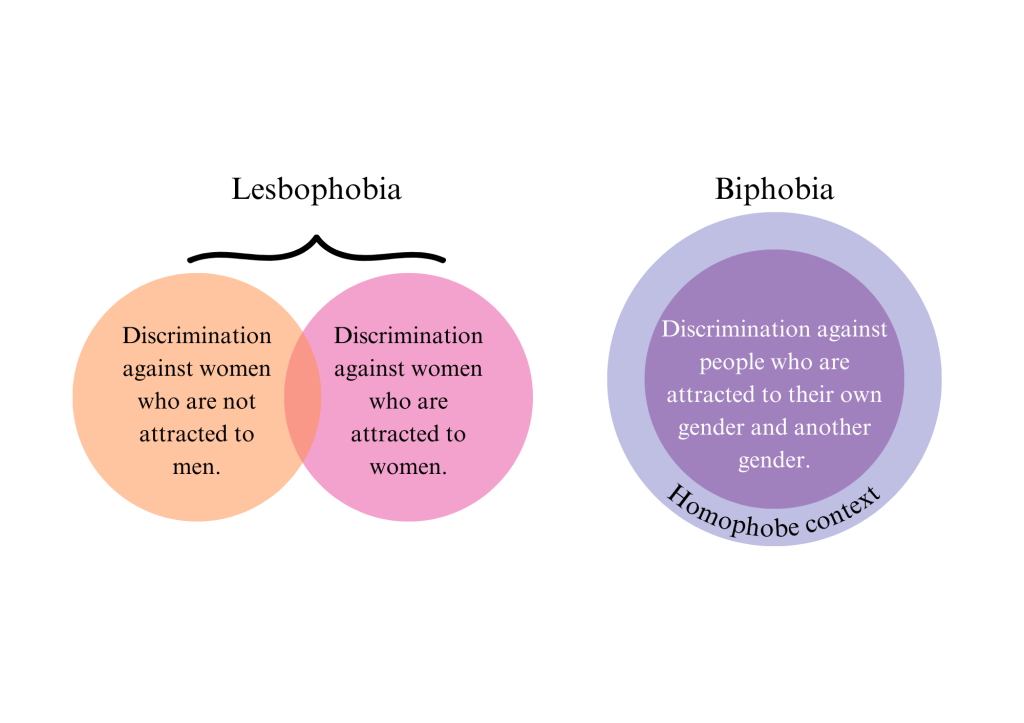
Figure 5: Simple Definition of Lesbophobia and Biphobia
Sufficient and Necessary Conditions for Discrimination
Lesbophobia operates like an additive structure: it can be broken down into several types of oppression, discrimination against women who are not attracted to men, and against women who are attracted to women. Each of these is a sufficient condition for lesbophobia on its own. Being perceived as loving women is enough to be targeted by lesbophobia, just as being perceived as not loving men is.
I’d like to focus specifically on this second condition: the one that targets women who turn away from men. Butch lesbians, for example, who reclaim masculine codes and detach themselves from heterosexual desire and the male gaze, are a clear illustration. They may be discriminated against and subjected to violence simply for being perceived as not desiring men. Even if single, a butch woman can be a target of lesbophobia.
Lesbophobia is decomposable. That’s not the case for biphobia.
You can’t break biphobia down into two separate forms of oppression: one against homosexuality and one against heterosexuality. This decomposition doesn’t work, first of all, because there is no structural oppression of heterosexuality. I will explain later why the devaluation of heterosexuality that some bi women experience does not amount to “heterophobia” (see the section “Manifestations of Biphobia vs. Lesbophobia in Romantic Relationships”).
Nor can you extract biphobia from its homophobic context. Biphobia emerges from the interaction between homosexuality and heterosexuality within a homophobic society. This dual presence of homo- and heterosexuality, combined with a homophobic environment, forms the necessary and sufficient conditions for biphobia.
Biphobia is what I call a reticulated oppression, that is, an oppression whose original components cannot be separated. In chemistry, reticulation is the process by which strong bonds, covalent bonds, for those who remember, form between molecular chains, creating an insoluble and infusible network.
So then, how can we distinguish lesbophobia from biphobia in practice? To begin answering that question, I propose that we take a closer look at lesbophobic and biphobic stereotypes, and what sets them apart, to provide a more concrete illustration.
Lesbophobic Stereotypes
Negative stereotypes about lesbians and bisexual women differ significantly.
Lesbians are often portrayed as unattractive, predatory toward straight women, masculine or tomboyish, aggressive, possessive, controlling, or as hysterical feminists. They are also commonly seen as man-hating and as imitating men in their relationships.
A specific form of fatphobia targets lesbians. They are often stereotyped as fat, and then mocked and degraded for it. One striking example of this kind of lesbophobic caricature appeared in the work of Bastien Vivès (see Figure 6). In it, a lesbian couple is depicted with one partner as a small, fat, butch, unpleasant woman, who dominates her tall, thin, large-breasted fem partner.

Figure 6: The Bastien Vivès Caricature (2022). Example of feminist backlash via a post by Cheek Magazine, July 21, 2022. The character on the left says « Stay topless, I said! You’re doing that for me, right? ». The comment of CheekMagazine: “TW: Lesbophobia
A wave of outraged comments has flooded the Instagram account of comic book artist Bastien Vivès after he posted a series of caricatured drawings targeting lesbians on Wednesday, July 20. Claiming, jokingly, to announce a fake deal for his series “The Lesbians” with Canal+, Amazon, and Warner (a false claim, typical of the artist’s often “satirical” second-degree style), Vivès published several illustrations depicting a lesbian couple using tired, offensive tropes about relationships between women. Reactions were swift, with users calling the drawings “cringey,” “lesbophobic,” and “sexist.” Critical comments continue to pile up beneath the post.”
This stereotype of the fat, masculine, and unfriendly lesbian has long been embedded in popular culture, as illustrated in the fictional work Matilda. Miss Trunchbull, a terrifying school principal, is coded as a misogynistic and anti-lesbian figure, used as a foil to the gentle, slim, and feminine schoolteacher, Miss Honey (Cumming, 2007).
Figure 7: Fatphobia and Lesbophobia – Miss Trunchbull as a Stereotypical Representation of the Fat, Unfriendly Lesbian. (From left to right: Matilda (1996), Matilda (2022), original illustration by Quentin Blake (1988)
Although Miss Trunchbull is not described as fat in the original book, only as athletic and authoritarian, she is portrayed as overweight in several of the most popular adaptations, including the children’s book illustrations and multiple film versions (see Figure 7). A 2022 press article by Smith reported that Emma Thompson, who played Miss Trunchbull in the Netflix film adaptation of Matilda, wore a fat suit for the role.
Biphobic Stereotypes
While bisexual women, especially those who are more masculine, can be targeted by lesbophobic stereotypes, they are generally not portrayed the same way. Biphobic stereotypes aimed at women are distinct. Bisexual women are often depicted as privileged, seductive, hypersexual and unfaithful, hyper-feminine, carriers of STIs, liars, manipulative, emotionally detached or psychopathic, attention-seeking thrill chasers, or heartbreakers.
One particular stereotype both connects and differentiates lesbians and bisexual women: the idea of predation.
Lesbians are commonly seen as predators of straight women.
Bisexual women, however, are portrayed not only as predators of straight women, but also as predators of lesbians.
A well-known example is Kathryn, the manipulative and incestuous bisexual character from Cruel Intentions (1999). She seduces Cecile, her innocent, straight victim, before tossing her into the arms of Sebastian, her half-brother and lover. As noted by Lind-Westbrook (2020), the infamous kissing scene between Kathryn and Cecile (see Figure 8) shocked American audiences, almost more than the incestuous relationship between Kathryn and Sebastian.
Figure 8: The iconic kissing scene from Cruel Intentions (1999), in which Kathryn “prepares” Cecile for her half-brother.
In The L Word, bisexual women are also portrayed as predators of women, particularly lesbians. In this major American lesbian series, three out of the five women who engage in bisexual behavior manipulate and exploit lesbians for personal gain.
One of them, Jenny, is among the most hated characters in the series. As Ten Eyck (2015) notes in her review: “Every one of Jenny’s relationships exists for her personal benefit or entertainment.”
The second, Adele, uses sex and manipulation to seduce and harm others. Her obsession with Jenny becomes central to the plot: she copies Jenny’s style, hair, and mannerisms, begins a relationship with Jenny’s ex, Niki, and then steals a sextape of the couple, which she uses to blackmail Jenny. Whether by trapping Jenny or dating Niki, Adele maintains a clearly predatory and toxic relationship with the women around her.
The third, Dylan, seduces Helena only to betray her by filing a sexual harassment claim, which turns out to be a setup.
Of the five women in the show who pursue both men and women, only two are not overtly predatory: Tina and Alice. Tina doesn’t clearly embody the biphobic predatory stereotype, but she still appears on Buzzfeed’s list of The L Word’s most hated characters (Karlan, 2016), notably because she cheats on her partner with a man.
Alice is the only one of the five bisexual-coded characters who isn’t portrayed as toxic. But by the end of the series, she declares that she can only fall in love with women, and clarifies that she is not bisexual.
It almost seems as though, to the writers of The L Word, the only “good” bisexual woman is one who isn’t really bisexual at all. A “true” bisexual woman, according to this logic, is a predator, especially toward lesbians.
As Squires (2019) writes in a blog post for bi.org, the bisexuality portrayed in The L Word is more like a phase or a code word for “untrustworthy.”
In summary, lesbophobic and biphobic stereotypes differ in key ways:
- Aggressiveness and masculinity are associated with lesbians,
- while dishonesty and hypersexualized femininity are projected onto bi women.
Lesbians are stereotyped as predators of straight women, while bi women are depicted as predators of both straight women and lesbians.
But stereotypes are only one way to distinguish lesbophobia from biphobia.
Manifestations of Biphobia vs. Lesbophobia in Society: Discovering One’s Sexual Orientation
Growing up without knowing it’s possible to love women is a consequence of lesbophobia, as I mentioned earlier. But growing up without knowing it’s possible to feel both heterosexual and homosexual attraction, that’s a direct consequence of biphobia.
Many bisexual women have told me they didn’t recognize their attraction to women, even when it was quite clear, because of internalized biphobic stereotypes. Their attraction to men disqualified them from identifying as lesbian. And because bisexuality is widely believed not to exist, their feelings for women were minimized or dismissed entirely. The result? A delay in understanding and developing their own sexuality.
In society, there are still narratives that dismiss lesbianism, reducing it to something experienced only by “ugly” women or women who’ve “never had good sex with a man.” However, public awareness campaigns, sex education, and LGBTQ+ advocacy work have significantly pushed back against these beliefs. Thanks to this work, young lesbians are more and more able to understand their orientation early on.
But for bisexual and pansexual youth, the situation is more complicated. When LGBTQ+ spaces, the very places that are supposed to offer guidance and representation, continue to promote the idea that bisexuality is just a phase or a transitional identity, it actively delays the sexual development of bi and pan people. Unfortunately, I have personally witnessed this dynamic in many of my conversations across international activist networks.
Case Study: Berlin–Astana
I lived and worked for several years in Astana, Kazakhstan, during the 2010s. For those unfamiliar with the country, I would describe it as follows: Kazakhstan is a former Soviet republic in Central Asia, with a majority Muslim population. It has one of the highest female literacy rates in the world and does not criminalize homosexuality. However, post-Soviet homophobia is still very present, and the country faces its own challenges regarding women’s rights and LGBTQ+ issues.
Personally, I felt safer as a woman in Kazakhstan than in France. While living there, I resumed my online LGBTQ+ activism, which I had completely halted during my time in Russia. I was not part of the local queer community in Kazakhstan, it does exist, but it is discreet and difficult to access.
After I returned to France, a former Kazakh colleague, let’s call her Gulnaz, reached out to me. She told me about a recent trip to Berlin, where she had met a woman and fallen in love at first sight. They had sex, and the experience deeply affected her. But she was confused and distressed. Her lover had told her that she could only be a lesbian or straight. According to this woman from Berlin, either Gulnaz had lied to herself about loving her previous male partners, or she didn’t truly love women.
When Gulnaz returned to Kazakhstan, she began to question all her past relationships and opened up to me about her anxiety. She told me that she truly felt she had loved men, and that she had also genuinely fallen in love with this woman.
I felt a wave of anger knowing that this colleague, who had no community support in Kazakhstan, had been fed such harmful misinformation by someone from the European LGBTQ+ community.
I witnessed firsthand how confused she was, to the point of doubting her own memories and feeling real emotional distress.
The woman from Berlin had likely benefited from the progress made by European LGBTQ+ activism, and the safety Berlin offers to explore one’s sexuality. It was unthinkable to me that she would use that position of privilege to “educate” a Kazakh woman by denying the very existence of bisexuality.
Gulnaz had already discovered her sexuality late due to the invisibility of lesbians and bi women in Kazakhstan. Now, an added layer of confusion came from biphobia in Berlin.
Back in Kazakhstan, she reached out to a mutual friend, let’s call her Zhanar, who told her to contact me and assured her that I was someone she could trust to talk about “sensitive” topics.
Zhanar and I had never openly discussed our sexualities, but I was convinced she was a lesbian, and clearly, she had guessed I was safe to talk to, despite my husband and two children.
So on one hand, you have Berlin, where bisexual women can be gaslit by fellow queers.
On the other, you have Astana, where a woman’s support network relies on subtext and the ability to sense who is safe, and on knowing which foreigner to message to confirm that bisexuality is, in fact, real.
Biphobia delays the sexual development of bi and pan women, that much is clear. But its impact extends much further, touching every aspect of their sexual and emotional lives.
Exploitation of Bi Women’s Sexuality
Another manifestation of biphobia is the control and degradation of the sexuality of women who engage in relationships with both men and women simultaneously. Whether polyamorous, swingers, or engaging in threesomes, women’s “bisexual” sexuality is often devalued, fetishized, and exploited, particularly in the porn industry. These women are also subject to intense pressure to frame their bisexuality in service of male pleasure. Threesome requests are one example. But this pressure can also take the form of an implicit expectation that their attraction to women be performed for or include their male partner. When a man suggests that his bisexual partner explore her sexuality only in his presence or with his participation, this is a clear expression of biphobia. When the only “acceptable” way for a bi woman to explore her same-gender attraction is via a threesome, never autonomously, it constitutes a form of guardianship or control over her sexuality.
I’ve already discussed how bisexuality is represented in pornography, and how bisexual scenes tend to be more violent and feature a higher number of combined acts, anal penetration, vaginal penetration, and oral sex, than either lesbian or straight scenes (see: The Symbolic Binationalism of Lesbos). Bisexual scenes are produced for the male gaze and male clients, rarely reflecting lesbian or queer aesthetics that appeal more to queer women. In that sense, bisexuality is exploited: bi women carry the erotic labor, but are rarely the beneficiaries of it.
In the broader exploitation of bi women’s sexuality, there is a significant cognitive bias I’d like to address. Having biases is neither inherently good nor bad, everyone has them, and they are common. What matters is that we are capable of identifying and changing our own biases. This is something we actively do when we educate ourselves about systems of oppression.
The bias I want to highlight is the tendency to frame harassment related to threesomes around lesbian experiences rather than bisexual ones.
Let’s consider the situation. A man approaches a woman online, in the street, or at a social gathering and proposes that she participate in a sexual encounter involving him and another woman. That other woman might be his partner, the partner of the woman he’s addressing, or even someone yet to be identified. Sometimes framed as a joke, the proposal is often persistent and argumentative. Caught off guard, the woman declines. She might be shocked, furious, or simply disoriented. In any case, she did not initiate the conversation and has done nothing to suggest she is interested in such an encounter.
Bisexual women are frequently subjected to this form of sexual harassment. Being sexualized without consent, repeatedly and aggressively, is a hallmark of sexual harassment. Lesbians, too, report this experience.
However, the harm experienced by lesbians when they are solicited for threesomes is more widely acknowledged than that of bi women, even though both are subjected to the same harassment. As a result, the violence is perceived as rooted in the fact that the target is lesbian, when in truth, no woman -lesbian or not- deserves to be sexually harassed for a threesome. The response, “But I’m not even attracted to men!” is a natural and valid one. Still, I find myself questioning the way this reaction shapes the narrative. I doubt that the bi woman being harassed was particularly attracted to the man either. Just like with street harassment, the issue isn’t whether we’re attracted to the person who catcalls us. It’s that they have imposed a hostile power dynamic, sexualized us without consent, and made sure we were aware, often leaving us afraid that the situation could escalate to physical or sexual violence.
This bias -centering the lesbian experience- also leads us to frame sexual harassment targeting a lesbian for a threesome as a form of lesbophobia, and never as biphobia. Why do I want us to reconsider this narrative? Because when lesbians are mistaken for bisexual women and mistreated on that basis, it is reasonable to conclude that biphobia is part of the equation. Denying this harms both bi and lesbian women.
Let me be clear: I am not denying the fetishization of sexuality between women. That fetishization absolutely exists and targets both lesbian and bisexual women’s sexualities. I’m also not pretending that these men care at all about women’s desires. Ultimately, whether it’s a lesbian or a bisexual woman, like all harassers, these men are rarely seeking to be desired in return; their goal is to assert sexual dominance over women they desire.
However, for the subset of men who fantasize about being desired in the context of a threesome, the “lesbian” sex they imagine is actually bisexual. And that is the phenomenon I want to talk about.
I’m not discussing consensual threesomes between interested and willing partners, but rather the persistent, invasive solicitations that create a hostile environment for both lesbians and bisexual women.
By framing this harassment as primarily lesbophobic, the interaction is often portrayed as a cishet man and a bisexual woman preying upon a lesbian. The first consequence of this framing: the bisexual community tends to politically disengage from the issue, since bi women are associated with the oppressor, not the oppressed. When a group is accused of wrongdoing, it typically responds in moral terms, not political ones.
Morality prompts individuals to renounce harmful behavior, even when it benefits them. Politics, on the other hand, is the process by which a group organizes to gain rights. In this context, the bi community often reduces the issue to a moral binary: “good” bi women don’t engage in threesomes, while “bad” bi women prey on lesbians alongside their male partners.
Because lesbians are typically cast as the primary victims of this phenomenon, it’s also expected that they be the ones to lead the political response. The moral burden is placed on bi women, while the political labor falls to lesbians. And yet, lesbians often have limited ability to take effective action on this issue. They are usually not present in swinger spaces or threesome discourse. Bi women, on the other hand, are more likely to be in those environments and have more leverage to intervene. Who better to reduce harm and prevent sexual violence in those contexts than bi women themselves?
If we instead acknowledged the clearly biphobic dimensions of this problem, we’d shift our understanding. On one side, there are bi women in relationships with men. Some freely choose to engage in threesomes and thrive in consensual, sex-positive spaces. Among them, some may be unaware that these practices are frowned upon in certain LGBT circles, simply because they don’t know the codes. But others face coercion: fetishized, pressured, or manipulated by their partners. Some experience a total violation of consent, such as when a man posts their couple’s photos on hookup apps without their knowledge or permission.
Some of these women even believe that threesomes are the only socially permissible way for them to explore same-gender attraction, either because it spares their partner’s ego, or because they lack access to queer-friendly spaces. All of these situations are direct consequences of biphobia: from the stereotyping of bisexuality as inherently threesome-related, to the isolation of bi women in heterosexual partnerships. Moreover, just like lesbians, many bisexual women are repeatedly harassed about threesomes without ever having consented to such attention.
Whether the bi woman is in a couple or is the one being propositioned, there are multiple angles that reveal the operation of biphobic systems.
It would be more accurate, and more effective, to reframe this dynamic by recognizing that there are often two victims here:
- the first, a bisexual woman who is fetishized, exploited, or isolated within her relationship with a man;
- the second, a woman who is harassed, most often bisexual herself, though sometimes lesbian.
By refocusing the conversation on the harm experienced by bi women, we gain clarity and political traction. If we understand bi women as the primary targets, and lesbians as secondarily affected, then our political response must prioritize the protection and agency of bi women, with the support of lesbians, rather than relying on bi women’s moral restraint and lesbians’ political labor alone.
In light of this, we must ask: is this primarily a case of biphobia or lesbophobia? And should our response be a moral one expected from bi women, or a collective, political one led by and for the bi community?
Why Is This Primarily Biphobia?
When a masculine-presenting cisgender woman is assaulted in a women’s restroom because she is mistaken for a trans woman, there is certainly a misogynistic element to the attack, but the violence is primarily rooted in transphobia. Julia Serano highlights this phenomenon in her work on the moral panic around trans people and public bathrooms. She explains how the rise in attacks against trans women in the U.S. also led to an increase in assaults against butch cis lesbians mistaken for trans women (Serano, 2021).
Similarly, when a masculine straight woman is mistaken for a lesbian and insulted, she is collateral damage of lesbophobia. When an effeminate heterosexual man is mistaken for a gay man and harassed, he is experiencing homophobia. And yet, we rarely acknowledge that when a lesbian is mistaken for a bisexual woman and treated with hostility as a result, she may in fact be experiencing biphobia.
We readily accept that bisexual women can be affected by lesbophobia, but the reverse is much harder to conceive. The notion that lesbians could be targeted by biphobia is largely absent from public discourse. When I began pointing out this dynamic, where lesbians are affected by biphobia, I was often accused of promoting counterproductive or divisive narratives. In the collective unconscious, lesbophobia is a real oppression, whereas biphobia remains suspect or lesser. People are willing to accept that bi women suffer from lesbophobia, since it is a validated form of violence, but the idea that lesbians might be impacted by biphobia is, for many, unthinkable.
For those who don’t genuinely believe that biphobia exists, the notion that lesbians could be affected by it is nearly impossible to accept.
So here’s the question I’d like us to consider together: is it possible that, on this particular issue, we’ve centered a lesbian narrative at the expense of bisexual women’s lived realities? Could it be that, despite the severity of the violence, the aggression in question is less about lesbophobia and more about biphobia?
I’ve spent a significant portion of this work arguing that bisexual women are directly targeted by lesbophobia. And yet here, I am asserting that in the case of harassment and sexual violence related to threesomes, lesbians are collateral damage. So how can we distinguish between someone who is directly targeted by a system of oppression, and someone who is incidentally affected?
The answer is actually quite simple: Can the person in question defend themselves by clarifying their identity? If the answer is no, if they cannot protect themselves by affirming who they are, then the oppression targets them directly. If they can clarify and thereby distance themselves from the attack, then the violence is primarily aimed at someone else, and they are experiencing a form of collateral damage.
Sexual Harassment Through Threesomes: Direct Oppression or Collateral Damage?
Earlier, I discussed the concept of « mistaken » harassment. For example, when a straight man is called a f*ggot, it is still an act of homophobia. Let’s apply the same logic to other scenarios:
- A masculine-presenting cisgender woman assaulted in a women’s restroom and accused of being a trans woman can defend herself by proving she’s cis.
- A straight woman mistaken for a lesbian can defend herself by asserting her heterosexuality.
- A feminine heterosexual man subjected to homophobic insults will typically defend himself forcefully by reaffirming his straightness.
But what about a lesbian woman who is sexually harassed with propositions for a threesome? Her instinct is generally to shut it down by saying, “I’m a lesbian.” I myself have pretended to be a lesbian just to be left alone with my girlfriend. And it worked. Never in my life would it occur to me to respond to unsolicited sexual advances by saying, “Sorry, I’m bisexual.” That would be absurd. I invite lesbians who believe that relentless threesome propositions are primarily lesbophobic, and not biphobic, to try using « I’m bisexual » as a defense. See what happens.
A woman who identifies as bisexual cannot shield herself from lesbophobic attacks targeting her relationship or her desire for women by reaffirming her bisexuality. She is not collateral damage of lesbophobia; she is a direct target. Likewise, she cannot stop inappropriate sexual propositions for threesomes by disclosing that she’s bi. She is the primary object of this form of harassment.
I’m not denying that there is a specific violence in refusing to acknowledge a woman’s lesbian identity, insisting that she sleep with a man when she feels no attraction to any man on the planet. But in the precise and specific case of harassment related to threesomes, lesbophobia is a secondary dynamic. It is absolutely legitimate to be enraged when treated like a sexual object by men. It is legitimate to be angry when your sexuality is treated as a challenge and men think they can « turn » lesbians. Lesbians are right to be outraged when they are harassed and their identity is disrespected. But they can also recognize when they are being targeted because they are perceived as bisexual, and come away from that experience with a deeper understanding of what bi women go through. These realities are not mutually exclusive.
Solidarity between lesbians and bi women will be more equitable when we acknowledge both the lesbophobia and biphobia bi women face, and the collateral effects biphobia can have on lesbians.
Lesbians have a vested interest in fighting biphobia. Lesbians will be treated better if bisexual women’s sexuality is no longer degraded and fetishized. On this issue, let us fight for ourselves. Let bisexual women organize and advocate for FF/M threesomes to be shaped and led by bi women, not by straight men. Let us work to ensure that sexual violence, including the unbearable harassment around threesomes, is recognized and addressed. Let’s demand comprehensive sex education centered on consent and the dismantling of power dynamics.
One of the simplest ways to empower bi women is to allow them to gather, to support one another. Isolation gives more power to the men in their lives. It’s much easier to convince a woman that she has no other options, that control, coercion, and exploitation are « normal » or « for her own good », when she’s alone. Bi women can defend themselves better when they are together, exchanging experiences and building mutual support.
Let me also highlight a deeply biphobic bias: the idea that a bisexual woman is complicit in her own exploitation, rather than a victim of it. I’m speaking of those women who come to believe that the only acceptable way to explore their bisexuality is through threesomes. I once spoke to someone who argued that « unicorn-hunting » couples (those seeking another woman to join them) are just looking for unpaid sex work to meet their needs, which is by definition exploitative. What I found striking was that single men on dating apps are never accused of the same thing. And yet, that’s exactly what it is. Men seeking quick hookups, without providing emotional or sexual reciprocity, are absolutely seeking free labor in the form of unpaid sex.
What makes “unicorn hunting” uniquely objectionable, apparently, is not that a man wants two women instead of one to exploit. It’s that a bisexual woman is involved, and active, in the dynamic. If she expresses sexual desire, it is automatically framed as predatory or exploitative. I’m not saying that women can’t commit sexual violence, or that no bi woman has ever harassed another woman. But when a man uses a woman to help him exploit two women, he is the predator.
As for casual sex and no-strings encounters, let’s stop treating bisexual women as the only ones morally culpable when they seek it out. Straight people, gays, and lesbians also pursue one-night stands. The desire to share a sexual experience does not inherently constitute exploitation. Bi women’s desire for such encounters does not make them predators. Nor does their desire to have group sex.
Threesomes can be ethical and consensual. I won’t insult your intelligence by rehashing the « ethically levrette claque doggy style » example. My goal here isn’t to define the perfect threesome, but to emphasize that bisexual women are best positioned to educate around it. They can reclaim power if we refocus on their needs. And that benefits everyone.
Biphobia is particularly visible in the way straight men exploit bisexual women’s sexuality. But the oppression of bi women also manifests in many other aspects of their intimate relationships.
Manifestations of Biphobia vs. Lesbophobia in Romantic Relationships
The couple is a specific site where biphobic discrimination can manifest. So far, I have mainly addressed the exploitation and fetishization of bi women’s sexuality in heterosexual relationships. However, biphobia can also manifest through jealousy and control. Some men attempt to regulate their bisexual partner’s friendships with other women specifically because of her bisexuality. This form of control is often accompanied by lesbophobia, particularly when these men express disgust, scorn, or dismissiveness toward their partner’s lesbian past or relationships.
In relationships between women, oppression can take the form of what is commonly referred to as internalized lesbophobia or internalized biphobia. Internalized oppression functions from self to self, when an individual has internalized social stigma and reproduces harm against themselves or their own community. Both bisexual and lesbian women can internalize lesbophobia, and bisexuals may also internalize biphobia. Common forms of internalized oppression include:
- Self-deprecation (e.g., “Maybe I’m not really bi; I’m probably just attention-seeking, people are right about me.”)
- Devaluing one’s own community (e.g., “I’m bi, but this community is so cringe that I refuse to be associated with it.”)
- Devaluing another bi person (e.g., “Bisexuals who keep whining about made-up oppression make us all look bad.”)
Lesbophobia can manifest in lesbian couples in various ways. These attitudes often signal internalized lesbophobia: hiding the relationship, feeling shame about it, refusing to attend Pride or LGBTQ spaces with one’s partner, or making claims that lesbian relationships are inherently dysfunctional or inferior to heterosexual ones. These are expressions of internalized lesbophobia because they stem from devaluing one’s own same-gender desire.
Biphobia in lesbian relationships takes different forms than it does in heterosexual ones. Beyond the occasional jealousy over male friendships (a mirror image of straight men’s jealousy over female friendships), most expressions of biphobia between women are distinct. I have come across numerous accounts in which women humiliate or infantilize their bi partners by speaking disparagingly about their past relationships with men. These comments often frame those relationships as sexually unfulfilling, inherently oppressive, backward, or “trashy.” This is not heterophobia, it’s biphobia. It targets the fact of having both heterosexual and homosexual relationships. Strictly heterosexual women are not subject to this kind of judgment, because they do not have same-gender partners capable of delivering such critiques. Straight women usually live in social and romantic contexts where their orientation is normative.
Similarly, when a woman weaponizes her lesbian relationship as a way to attack her ex-girlfriend who is bisexual, claiming, for instance, that her ex only dated her for a thrill, to be “cool” or “edgy,” or to titillate men, this is not hatred of heterosexuality, but of bisexuality. After all, to be accused of being “too straight” by one’s girlfriend, one must have had a girlfriend. No woman who strictly follows a heterosexual life path is exposed to that kind of accusation. This reinforces that what is being targeted is not heterosexuality, but the perceived illegitimacy and inauthenticity of bisexual desire itself.
Case Study: Madonna and Shimizu
The weaponization of bisexual women’s lesbian relationships within the LGBTQ community was exemplified in the media treatment of Madonna’s bisexuality. In a 2024 interview, her ex-partner Jenny Shimizu described their relationship as a form of prostitution, explaining that Madonna would send her private jet to bring her over whenever she felt like having sex. Shimizu added that, at the time, « you couldn’t say no to Madonna. »
But Jenny Shimizu was hardly a powerless young woman. She was a supermodel, a class of celebrity models whose fame and income in the 1990s went far beyond conventional modeling. She was a Calvin Klein icon and also dated Angelina Jolie during that period. If anyone had the ability to say no to Madonna, it was Shimizu. Her cultural aura was massive. And notably, she didn’t describe the relationship as coercive, she said she loved that period in her life.
This isn’t a case of someone naming sexual violence. It’s a case of someone drawing on the vocabulary of sex work, power dynamics, and exploitation, despite both women operating in the same social class, despite the absence of any transactional sex, and despite her own clear pleasure in the relationship. When Madonna flew her in on a private jet, what Shimizu « got » was sex with Madonna, something both parties evidently enjoyed. This was not prostitution. Shimizu was not providing sexual labor to Madonna in exchange for compensation. She was engaging in casual sex with Madonna, and getting just as much out of it as Madonna did.
Whether Shimizu intended to damage Madonna’s image or was unaware of how negatively these statements would be interpreted out of context remains unclear. Most of the interview simply recounts the excesses of two famous women in the jet-set scene of the 1990s. But the celebrity press seized on that line. One tabloid headline read: “Madonna’s Ex Jenny Shimizu Felt ‘Like a High Class Hooker’ While Dating the Singer” (Andaloro 2024). The framing of Madonna as a predatory bisexual exploiting lesbians follows a familiar biphobic trope.
Bisexual women’s lesbian relationships should not be weapons the queer community gets to use against them at will.
This narrative predates the 2024 interview. In 2023, a major French lesbian Instagram media account, one I’ll leave unnamed, shared a post featuring Madonna and her past female lovers with the caption: “Madonna and her lesbians as accessories.” That too was a biphobic take. The degradation of bisexual women via the instrumentalization of their past lesbian relationships is a classic manifestation of biphobia. If such comments come from another bisexual woman, it’s a case of internalized biphobia. Bisexual women are not immune to being biphobic toward their bi partners. If they come from a lesbian, it’s simply biphobia.
Lesbophobia and biphobia take different forms in the romantic lives of bisexual women. In many cases, isolation plays a critical role. Because biphobia is pervasive in LGBTQ spaces, many bi women struggle to find environments that center their needs, safety, and autonomy. In that solitude, their romantic partner often becomes their sole source of trust. When the relationship is healthy, that can be a gift. But when biphobia is present in the couple, they have very few places to seek support.
It’s crucial, then, to understand that intimate partner biphobia doesn’t occur in a vacuum, it’s enabled and reinforced by systemic biphobia, which produces the conditions of isolation and vulnerability that so many bi women face.
Which brings us to the next question: beyond interpersonal dynamics, how does biphobia operate at a systemic level?
Part 4 – Systemic Biphobia
Individual oppression occurs from one person to another. This is the form of oppression that most bisexual women are familiar with, and which has been documented, for example, on @payetabi on Instagram. These experiences are serious and real. The fact that bisexuals have not been heard, and have had to repeat the same message for over fifty years, does not make the issue any less important. However, these experiences are not, in themselves, manifestations of systemic oppression.
The concept of systemic oppression was popularized by Black Power activists Stokely Carmichael and Charles Hamilton in 1967. These two thinkers distinguished between racism perpetuated by individual white people against Black individuals, and the broader oppression created and maintained by the system itself (Carmichael & Hamilton 1967).
Systemic oppression is not the result of an individual’s intent to oppress. No one is pressing a button or consciously choosing to discriminate when it comes to systemic oppression. It unfolds passively and arises from the structure of the system. Systemic oppression affects all minority groups and manifests in many everyday situations. Sonya Renee Taylor puts it clearly: “Systems do not maintain themselves; even our lack of intervention is an act of maintenance. Every structure in every society is upheld by the active and passive assistance of other human beings.” (Taylor 2021).
To illustrate this phenomenon, it’s common to ask people to imagine a world in which everyone is well-meaning, and then observe what continues to oppress. What remains is the system itself, along with its institutions. When a child born to trans parents doesn’t fit into the existing data fields of a government database, and even the most well-intentioned public employees can’t find a solution to register the child, that’s not an individual problem. That is a systemic one. In a transphobic system, trans mothers have even been forced to adopt their own biological children (Collectif Famille·s 2023).
Systemic oppression is also known as institutional oppression because it originates from institutions. This includes oppression enacted by collectives, businesses, media outlets, the cultural industries, the medical system, public administration, religious bodies, communities, and governments.
Institutional oppression can also stem from individuals, but only under specific conditions. When someone acts as a representative of an institution and discriminates in their official capacity, their individual act also constitutes institutional oppression. For example, a public employee who discourages you from filing an application because of their prejudice against your minority status is harming your access to the services of that institution. Similarly, a stigmatizing cultural product constitutes institutional oppression, especially when it has a wide reach and reflects dominant discourses. Artists, public figures, and journalists who amplify or legitimize hate speech are not just individuals perpetuating individual oppression. The cultural institution to which they belong becomes an agent of systemic oppression. The police officer, doctor, journalist, or artist who derives authority from an institution participates in institutional oppression when they discriminate in their professional role.
Finally, when a group of individuals mobilizes to oppress another group, this too constitutes a manifestation of institutional oppression. For example, when members of a Catholic parish gather to march against LGBT rights, this is not just the action of individuals, it is an act of institutional oppression by the Catholic Church as an entity, targeting LGBT people.
In short, systemic oppression is the product of collective structures, such as institutions and their representatives. It encompasses any action, active or passive, that maintains the status quo or reinforces discrimination embedded within the fabric of society. With this in mind, I would like to turn to something often dismissed as a minor or insignificant issue, which I believe is, in fact, a central feature of institutional biphobia.
The Sabotage of the Bisexual Community
Bisexual women were not welcomed in either lesbian or feminist circles in the 1970s and often felt deeply excluded (Wohosheni 2024-b). Logically, many bi women fought for their inclusion. Faced with repeated failures, some also attempted to organize independently. Unfortunately, bisexual organizing has often been actively discouraged, most notably through intense harassment, often originating from certain segments of lesbian communities.
In the U.S., the emergence of a radical and autonomous bisexual activist movement dates back to the 1980s, following the bi coming-out of Lani Ka’ahumanu, a former lesbian activist. Her bisexual advocacy exposed her to a sustained campaign of harassment within the lesbian community (Rose 2022).
In 2020, after I publicly denounced biphobia within certain lesbian spaces, I was subjected to a wave of cyberharassment of unprecedented intensity. For context: at the time, I was actively engaged in fighting homophobia and transphobia within Christian spaces and had gained some national media visibility. As expected, I had already been targeted several times by online hate from neo-Nazis and religious extremists. And yet, after nine years of LGBTQ activism online, the largest campaign of harassment I ever endured came from a specific fringe of the lesbian community, when I began to speak openly about biphobia in those circles.
For several days, hundreds of hateful comments flooded my account. My name was dragged through the mud on Twitter threads involving lesbians and trans men, where users were urged to block me and cut contact. My primary care doctor diagnosed me with post-traumatic stress disorder, prescribed medication, and ordered medical leave.
The insults were accompanied by explicit threats: some claimed that lesbians had decided to “beat me up” if they saw me at La Mutinerie, a queer-lesbian bar in Paris. At the same time, malicious rumors began circulating in an attempt to damage my public image and discredit my activism. It was claimed, for example, that I was being paid by the Catholic Church to infiltrate the LGBTQ community, pretend to be queer, and destroy the movement from within. Another rumor alleged that I had brought my husband into this lesbian bar to « infiltrate » it, and that we were both thrown out. Some even falsely claimed to have witnessed it firsthand.
The reality was entirely different. I was, of course, not being paid by the Catholic Church, I have never received any payment for my activism. As for my husband, a contemplative man raised in traditional Catholic circles, he was often uncomfortable with society’s sexualized culture and had never set foot in a queer space or event, despite always supporting my advocacy and my pro-LGBT spiritual journey. The staff at La Mutinerie, for their part, had always shown me kindness, demonstrating clearly that the entire lesbian community did not condone the harassment.
Despite being known for years as a “queer Christian,” the reserved, uncool religious activist, I was amused (and a little disturbed) to see that this new invented narrative cast me as part of a disgraced swinger couple, allegedly trying to “pick up” women at La Mutinerie. That fabricated story also attempted to falsely implicate the bar itself in endorsing biphobic attitudes, which was completely untrue.
To be clear: I have nothing against swingers. I was simply shocked that, after years of being perceived as the prudish and religious figure of queer Christian circles, this was suddenly the life people had decided to assign to me. Even now, five years later, a trans women friend involved in the Paris queer scene recently told me she tests the waters by casually dropping my former pseudonym “queer chrétien·ne” into conversation. If it sparks an angry rant about my content, she stays silent, mentally labels the person as toxic, and keeps her distance. Apparently, both I and that old video of mine remain divisive topics in certain Parisian circles. I wasn’t exactly thrilled to learn that my former handle had become a kind of « toxic person detector » in the underground scene.
The harassment of bisexual activists goes far beyond isolated experiences. It is a structural phenomenon that also targets bi-led collectives.
Case Study: The Harassment of the Front d’Action Bisexuel (FAB)
When the Front d’Action Bisexuel (FAB) was launched in September 2024, it found immediate success, fueled by its promise of bold, explicitly political bisexual activism. Within a week of its creation, however, the group became the target of an online harassment campaign (see Fig. 9). What was the FAB’s crime? Presenting its three founders, accused of all being white, using the word “radical” in its bio, and organizing in a space that explicitly excluded cisgender men.
I am unaware of any feminist or LGBTQ+ collective that has faced mass harassment from other feminist or queer activists on the basis of such accusations. Yet this describes a perfectly ordinary structure, one shared by at least 90% of radical queer and feminist collectives in France.
Figure 9: Example of Online Harassment Targeting the FAB. Post from September 25, 2024, by “Le petit Nicallout,” an account dedicated to exposing intra-community violence. Translation: “Reflection on the Ongoing Dogpile Targeting a Bisexual Account – By Chasuble.
During this Bisexual Visibility Month, several new accounts run by bi collectives have emerged. One of them gained over 2,000 followers in just a few days. Great news for the bi community, right? Well, not exactly. Some of the collective’s positions were contested, and it is now at the center of a community-led harassment campaign.”
Among the most active harassers were radical lesbians and bisexual women seeking to distance themselves from the « bad bisexuals » of the FAB. During the harassment campaign, statements circulated such as: “I’m a repentant biphobe, but seeing the FAB’s creation makes me want to take it all back,” and “We’ll never stop coming for you.” This campaign unfolded at a moment when the FAB had posted nothing more than a basic introduction of its founding members. They were literally being attacked for existing , and for clearly stating that this was a political bisexual organizing account.
Very few public figures came to the FAB’s defense at the time. Many feared that supporting them would make them targets too. “I barely get anxious when I get an Instagram notification now,” one of the co-founders told me months later. They had also been signed off work by a doctor right after the incident.
Three months after the initial wave, a second online harassment campaign began , this time targeting a post that centered the contributions of bisexual women in different-sex relationships. The post went viral, gaining over 9,000 likes. It reminded readers that, statistically, bi women are more likely to experience intimate partner violence than heterosexual women, and that isolating them is a mistake. The text attempted to highlight positive, empowering ways bi women in hetero relationships resist gender norms and binaries in their everyday lives.
The backlash was swift. Over the next few days, FAB and bi women were ridiculed online. A lesbian humor account with 2,000 followers stoked the hate further. The account reposted a gay man’s quote: “It was a cis bi chick in a straight relationship who threw the first brick at Stonewall.” Then it shared a trans person’s aggressive story post, which read: “We have better things to do in ‘the community’ than cater to your insatiable need for attention.”
The lesbian account continued by sharing another series of inflammatory posts, this time from a bisexual person who wrote: “Counting and detailing every aspect of your life that could resemble oppression is outrageous in the current global context. (…) Besides whining and sucking yourselves off like a bunch of good little HSBC [Note: Acronym in French feminist circles meaning ‘White Straight Cis Men’], we are not with you at all. A good number of bi folks would spit in your face.”
All of the posts and stories the lesbian account highlighted came from smaller accounts with relatively limited audiences. The account added: “Why don’t most of my bi friends relate to the FAB? Why, when we read your stuff, does it feel like we’re watching a film written by Noémie Merlant?” (Note: Merlant is a French actress known for playing a lesbian role in Portrait of a Lady on Fire and a trans role in A Good Man. In queer circles, her performances have sometimes been criticized due to her presumed heterosexuality.)
All the classic biphobic tropes were present in the messaging: bisexuals portrayed as privileged and attention-seeking; their contributions to LGBTQ+ activism minimized; and their efforts to speak about biphobia framed as spoiled-brat tantrums. The intent wasn’t just to humiliate the FAB, but also to make it appear that the harassment was coming from within the bisexual community itself , despite the FAB’s rapid and widespread support among bi and pan people, and the fact that the primary amplifier of this harassment was a lesbian account.
Less than a month later, the FAB became the most-followed bisexual collective on French Instagram and was hit with a third wave of harassment.
This visceral backlash against bi organizing isn’t just unfortunate , it’s strategic sabotage. The use of bisexuals with strong internalized biphobia as a front, and the collusion between gays and lesbians to delegitimize bisexual organizing, is a longstanding problem.
Bisexuals Are Expected to Advocate for Others, but Not for Themselves
If we can convince bisexual women that they are privileged, if we succeed in extinguishing within them any desire to recognize their own oppression, then we can ensure that they never reach the point of wanting to organize collectively. Shiri Eisner describes how bisexuals internalize these biphobic discourses and ultimately do not fight for their own rights:
“In “LGBT” settings, Obradors mentions many bisexuals’ tendency to neglect bisexual activism while contributing most of their time and energy to the GGGG movement. Indeed, many bisexuals even go as far as denying that a separate bisexual struggle is needed or that unique bisexual issues exist. (…) In heterosexual contexts, the same dismissal of bisexuality and its related issues occurs in relation to other topics, as many bisexual activists prefer to contribute their efforts to struggles that are perceived as “more important” than bisexuality on the metaphorical oppression hierarchy.” (Eisner, 2013)
This kind of rhetoric is echoed without challenge in lesbian spaces, where bisexuality is often portrayed as a politically weak identity and as inherently privileged. It is impossible for a bisexual woman to engage in lesbian communities without encountering these ideas.
One recent example comes from a viral 2024 video published by the account Subwaytakes. The concept is simple: a man sits in the subway and hands a microphone to random people to speak their minds. In this video, the subject is the “gentrification” of homosexuality by bisexual women.
According to the French Wikipedia definition, gentrification refers to the transformation of working-class neighborhoods due to the arrival of more privileged groups, who rehabilitate housing and impose different consumption habits. Gentrifiers often trigger housing dynamics that impoverish and displace preexisting local populations, they are the urban and social equivalent of parasitism in nature.
The episode is one minute long. “A lot of queer people lead heterosexual lives,” says the young woman featured in the video. “I am looking at gentrifier bisexuals specifically,” she adds (Subwaytakes, 2024). This video garnered 1.5 million views on Instagram. It disturbed many of my bisexual contacts but remains a textbook example of the decades-long campaign of demoralization in which bisexuality is framed as a privileged identity infiltrating the LGBTQ+ community.
Christine Delphy, in Thank God I Am a Lesbian, a Canadian documentary from 1992, openly stated that she did not believe in the existence of “true” bisexuality. Referring to “true bisexuality,” she said: “I have the usual, very common reaction of lesbians and gay people, which is that it’s a sham and, politically, a treason.” This is not merely individual biphobia. When one of the most prominent French lesbian intellectuals speaks on behalf of the gay and lesbian community in a film produced and broadcast within that community, claiming bisexuality doesn’t exist and is politically treacherous, it constitutes collective biphobia. Delphy is far from alone in these sentiments; a long sequence in the film features interviewees declaring that being bi is impossible, that bisexuality doesn’t exist, or that bisexuals just don’t know how to choose.
These aren’t just isolated personal views. These biphobic positions were highlighted, unchallenged, by the film’s directors, Laurie Colbert and Dominique Cardona, who clearly intended to platform biphobic ideas. The film has faced no backlash in the three decades since its release. To this day, it is freely available on YouTube, where it continues to receive enthusiastic responses and is considered a valuable and positive resource within the lesbian community. This is undeniably lesbian community biphobia.
Stéphanie Ouillon (Wohosheni), artist and historian of bisexuality, has demonstrated the systematic discouragement of political organizing by bisexual women in France during the 1970s through her analysis of the FHAR (Front Homosexuel d’Action Révolutionnaire) archives. These records show that bisexual women were present, that their demands to speak or organize around bisexuality were silenced, and that they were ordered to advocate for homosexuality only.
This exclusion is even acknowledged as a deliberate political tactic of the FHAR in Carole Roussopoulos’ 1971 documentary Le FHAR. The filmmaker explicitly raises the topic of bisexuality and hands the microphone to a lesbian activist, who justifies silencing bisexuals as a strategic move by the group. Then, the documentary cuts out the beginning of a protest from a bisexual activist present (Wohosheni, 2023). This illustrates that the deliberate targeting of political bisexual organizing in favor of strictly homosexual activism has been active for more than fifty years in different western countries.
And the strategy worked. Between 1970 and 2010 in the United States, less than 0.02% of all LGBTQ+ funding was allocated to bisexual-focused projects (Bowen et al., 2012). Bisexuals do engage in activism, but not for themselves.
Eisner already pointed out this exploitative dynamic, where bisexuals’ activist labor benefits other sexual minorities:
“The products of the work of bisexual activists are often used for the benefit of gay people, without reflecting back on the bisexual community for either visibility, symbolic capital, or various material gains. Indeed, bisexuals have been some of the founders and leaders of the gay liberation movement, yet have either had their importance and contributions dismissed or their bisexuality erased. As a classic example of this, Obradors mentions bisexual activist Brenda Howard, who thought up and initiated the first pride march after the Stonewall rebellion, and whose seminal donation to the LGBT movement has been all but erased from community history.” (Eisner, 2013)
Thus, the exploitation of bisexual labor and the sabotage of bisexual community organizing have severely delayed progress in terms of rights and protection against discrimination. The loss to the bisexual community is incalculable. We’re talking about lost decades and about activists worn down and damaged by harassment and silencing.
But how many decades, exactly, have we lost?
How Can We Measure the Delay in Bisexual Activism Caused by Sabotage?
When I set out to estimate how far behind bisexual activism had fallen, I needed a tangible indicator to compare the development of gay, lesbian, and bisexual activism. I had to identify comparable phenomena across the different groups, without erasing bisexuals’ impact. Otherwise, I was sure to overestimate the delay I was attempting to measure.
For instance, if I chose to compare the number of bisexual bars with those labeled gay or lesbian, I might end up with the mistaken impression that bisexual activism had barely begun. But the absence of bisexual-only bars doesn’t mean that bisexual activists have no influence on society. Moreover, that would be an indicator of economic vitality, not of social impact.
I needed a stable metric, something I could track from the 1960s to today, that was standardized and reflected our deeper social concerns. I chose to look at academic publications, and more specifically, three types of work (see Figure 10):
- Articles including multiple sexual orientations,
- Thematic articles, and
- Highly specialized publications.

Figure 10: Definition and Examples of Inclusive, Thematic, and Highly Specialized Articles.
The advantage of this method is that it allows me to estimate the number of publications per year from 1960 to the present, using a stable and standardized indicator. Every year, millions of scholarly articles are published. The articles I relied on for this study are not blog posts or informal essays, they are peer-reviewed pieces published in academic journals or edited volumes, ensuring a baseline level of scholarly rigor.
This approach also makes it possible to quantify bisexual activism and its societal impact, even when that impact is small or indirect. While this methodology has its own limitations, it seemed to me to be a valid proxy for assessing the penetration of gay, lesbian, and bisexual issues into the academic and, by extension, the social sphere. A detailed explanation of the article search methodology and the raw data used can be found in the Appendix.
As a first step, I focused on bisexual-themed articles, those that include the word “bisexual” in the title, but not “lesbian,” “gay,” or “homosexual.” In other words, these are articles that center bisexuality, even if they mention other identities in the body of the text.
I then identified the point in time when the number of thematic articles about homosexuality (grouping lesbians and gay men together) reached an equivalent volume. This method reveals a 39-year delay in achieving scholarly autonomy for the bisexual community (see Figure 11).
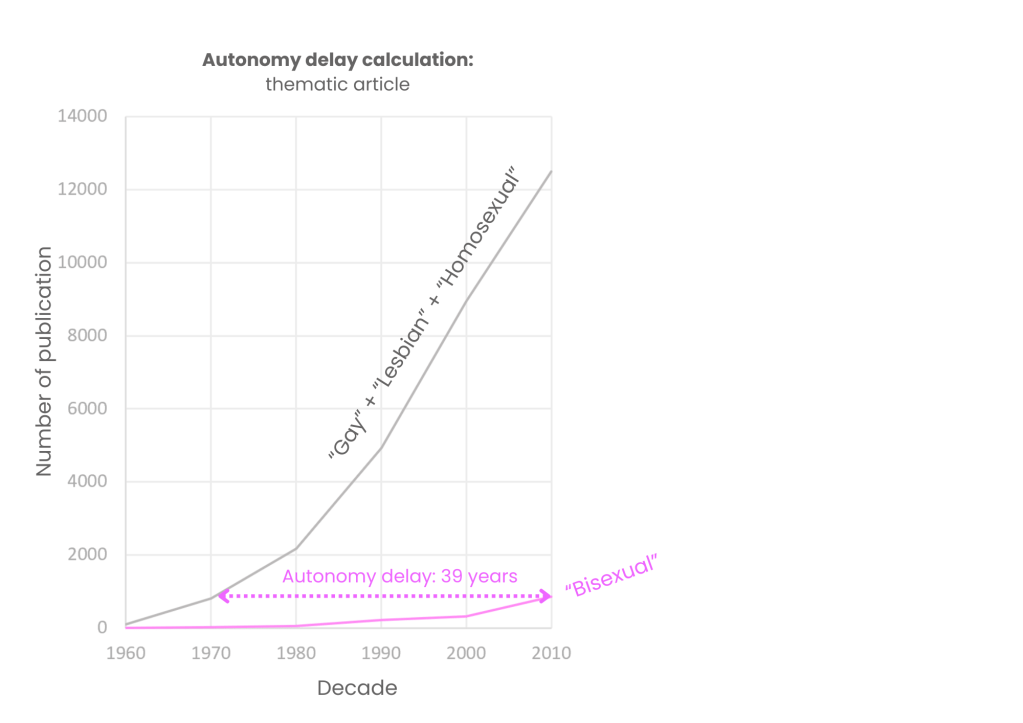
Figure 11: Estimated Delay in Autonomy Based on Thematic Articles Focused on Bisexual People vs. Gays, Lesbians, or Homosexuals, by Decade (1960–1969 to 2010–2019).
In a second phase, I examined the number of highly specialized scholarly articles on bisexuality, that is, publications with the word “bisexual” in the title that do not include the terms “gay,” “lesbian,” or “homosexual” anywhere in the body of the text. I then identified the point in time when the number of highly specialized articles about gay men equaled that of articles about bisexual men, and did the same comparison for articles on lesbians versus those about bisexual women.
Because it was difficult to assess which “homosexual” articles referred jointly to gay men and lesbians, and which focused on one or the other, I excluded articles centered solely on the keyword “homosexual” from this calculation. As a result, this method underestimates the extent of the delay in bisexual advocacy and scholarship, but it still allows us to assess whether the delay has been different for bisexual men and bisexual women.
Using this method of calculation, I estimate the autonomy gap to be 37 years for the bisexual women’s community (Fig. 12) and 47 years for the bisexual men’s community (Fig. 13). This clearly shows a differing timeline in the development of autonomy between men and women within the bisexual community.
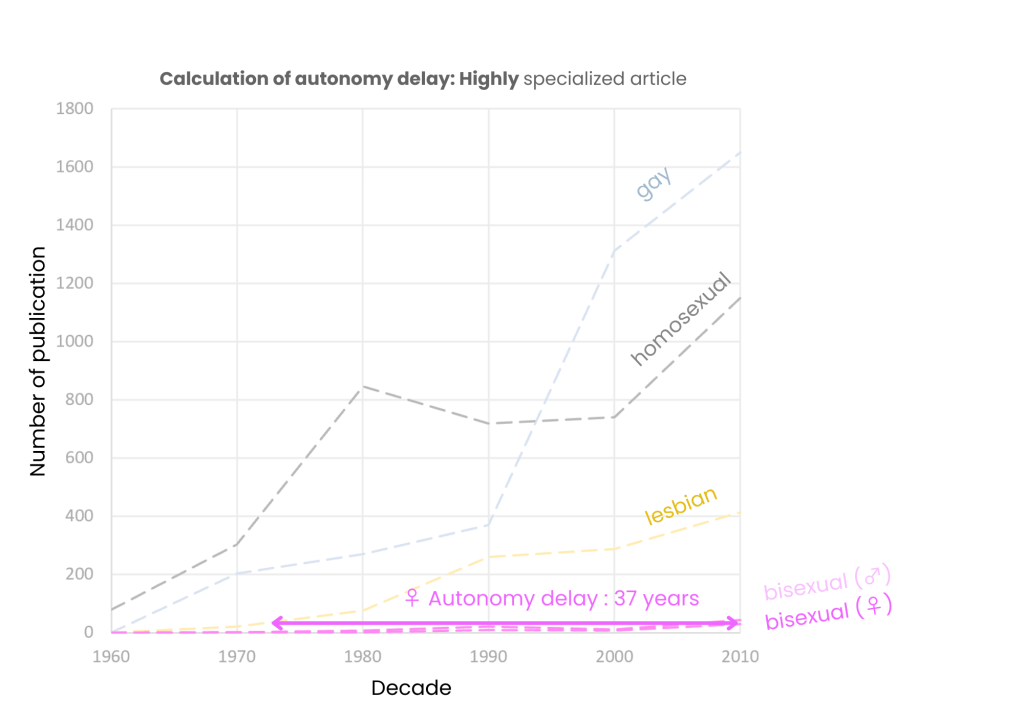
Figure 12: Estimated Delay in Autonomy for the Bisexual Women’s Community, Based on Highly Specialized Literature Using the Keywords “gay,” “lesbian,” and “bisexual,” Published by Decade from 1960–1969 to 2010–2019.

Figure 13 : Estimated Delay in Autonomy for the Bisexual Men’s Community, Based on Highly Specialized Literature Using the Keywords “gay,” “lesbian,” and “bisexual,” Published by Decade from 1960–1969 to 2010–2019.
While the autonomy gap is one measure, the question of inclusion is another. I also felt it was essential to assess the place bisexual people occupy within the broader LGBT community and to evaluate both the degree and possible delay of their inclusion.
Inclusion Gap
To calculate this, I looked at all generalist articles that include the word “bisexual” in their title, whether the article focuses solely on bisexual individuals or also includes gay men or lesbians. By comparing the literature that includes bisexual women with that which includes lesbians, and bisexual men with gay men, I was able to estimate the inclusion gap. The result: a 14-year delay for bisexual women and a 20-year delay for bisexual men (Fig. 14).
For simplicity, I did not include articles using the keyword “homosexual” in their title, which means this is a conservative estimate of the actual inclusion gap, likely even larger in reality. Moreover, these estimates are approximate. They do not, for example, take into account that the bisexual population is larger than the combined lesbian and gay populations. Logically, with equal levels of activism, we should expect more articles on bisexuality, not fewer. Therefore, the findings here likely underestimate the gap, on two different counts.

Figure 14 : Estimated inclusion gap based on articles including the different LGB communities, published by decade from 1960–1969 to 2010–2019.
Based on this academic indicator, the number of peer-reviewed publications per decade, between 2010 and 2019, the bisexual movement shows a delayed timeline compared to lesbian activism: a gap of 37 to 39 years in terms of autonomy, depending on whether we look at ultra-specialized or thematic articles, and a 14-year gap in terms of inclusion. The gap is even wider for bisexual men compared to gay men, with an autonomy delay of between 39 and 47 years, and an inclusion gap of 20 years. These figures point to a systemic difficulty within the LGBT community to fully include bisexual people, and suggest that attempts at autonomous bisexual activism remain significantly behind.
This delay, which I partly attribute to the institutional biphobia within the LGBT community, has concrete consequences.
Do you remember the thought experiment I proposed earlier, imagining a society where every individual is benevolent, and yet the system continues to oppress? Let’s try that thought experiment again: imagine that the lesbian community is made up solely of the kindest, most open-minded lesbians imaginable. Picture a lesbian who warmly welcomes bisexual women into lesbian festivals, who consistently reassures her bi friends about their place and legitimacy within the queer community, who defends bisexual people when she hears biphobic jokes, and who speaks out publicly against their harassment.
Indeed, many lesbians are true allies to bisexuals. So let’s imagine that these are now the only lesbians bisexuals ever encounter. We are in 2025, and everyone is kind.
And yet, despite this total goodwill, the bisexual community still lags nearly four decades behind. It still consists mostly of a handful of Instagram accounts and enthusiastic, motivated but scattered collectives. The primary point of entry for bi women into the LGBT community continues to be the lesbian community.
The Lesbian Community as the Endpoint for Bi Women – and Its Consequences
In response to society’s homophobia, lesbians created their own spaces. In these environments, they reclaim power and affirm their identity: they love women and are not attracted to men. This affirmation often includes mocking the forces that oppress them, namely, men and heterosexuality. It takes the form of jokes, references, sketches, slogans. It’s important to stress that this is a legitimate, healthy, and beneficial response for lesbians.
By this, I mean slogans like “libère nous du mâle”[2], jokes about how long it takes a lesbian to take off her rings before sex being equivalent to the time needed for a heterosexual encounter, stand-up bits where a comedian mimics humiliating straight sex with a mediocre man from the time she still thought she was straight, or posts jokingly praying for the hopeless case of straight women.
[2] The phrase “Deliver us from man” is a translation of the French feminist slogan « Libère-nous du mâle », a play on words derived from the Christian prayer « Délivre-nous du mal » (“Deliver us from evil”) since evil (mal) and male sex (mâle) sound the same in French.
This would be harmless, if there were a parallel bi-lesbian space, and if this understandable coping mechanism didn’t end up shaping the experience of bisexual women trying to exist in lesbian circles.
A bisexual woman in a relationship with a man, who engages with the lesbian community, will be repeatedly exposed to negative commentary about straight couples. While this kind of humor may be empowering and healing for lesbians, it is not neutral for bisexual women, who rely on different survival strategies when facing homophobia. In my view, bi women benefit more from psychological tools rooted in self-compassion than from those built around pride or identity affirmation.
Bisexual women in heterosexual relationships who immerse themselves in lesbian spaces often end up feeling ashamed of their partner and their relationship. This isn’t “heterophobia”, it’s structural biphobia. Straight women, by contrast, can move freely through mainstream feminist spaces where their relationships are the norm, and where the sexist violence they endure in their couples is met with solidarity rather than infantilization or shame. And if straight women feel out of place in lesbian spaces, they can simply choose not to engage, it won’t affect their lives.
Bisexual women, however, are present in lesbian spaces because of their same-sex attraction and because there is no robust, organized bisexual community for them to turn to. It’s the coexistence of their same-sex and different-sex desire that leaves them vulnerable, no matter where they go, part of their desire is likely to be marginalized or shamed.
This is a structural issue: even when surrounded by lesbians who are not overtly biphobic, bisexual women cannot truly thrive in a space that isn’t built with them in mind. The absence of a bisexual community exposes them to persistent and pervasive negative messaging, where part of who they are, specifically, their attraction to men, is treated as less valid, less desirable, and even shameful.
The lack of a bisexual community, caused by the systematic suppression of bisexual organizing within the LGBT movement, has created this situation. And the delay in bi activism has consequences not only within the queer community, but throughout broader society.
The Case of Domestic Violence Support Services
Bisexual women are more likely to experience intimate partner violence than both heterosexual and lesbian women (Bermea et al., 2018). And yet, state-supported domestic violence services are overwhelmingly designed with heterosexual victims in mind. There is no dedicated training for supporting bisexual women, despite the fact that they are among the most affected, or for lesbian women, for that matter. Most people in society are unaware that intimate partner violence presents specific risks for bisexual women. This invisibility compounds the problem: faced with institutions where their experience may be poorly understood or invalidated, bisexual women are significantly less likely to report abuse than either heterosexual or lesbian women (Flanders et al., 2019).
It can be difficult to fully grasp how biphobia functions within these dynamics, so I invite you to a thought experiment. Picture yourself in the following scenarios.
First, consider a situation that is typically bisexual: you have experienced sexual violence in the context of a group encounter involving both men and women. Who could you turn to for help without fear of being judged? What kind of professional might seem open-minded enough to hear your story without projecting bias? A police officer? A social worker? Your general practitioner?
Now imagine that you’ve left your husband to start a new life with a woman, and in response he becomes violent. Or, in the opposite case, imagine you have a history of lesbian relationships and your current male partner constantly devalues you for it, channeling his resentment into controlling jealousy. You try to raise the issue with a loved one or with your doctor. They respond by suggesting you should try to understand him, « it’s only natural, » they say, that he’s taking it badly or feels insecure.
Or picture this: you’ve fallen deeply in love with a woman while being married, and within the context of an affair, she begins physically abusing you.
Would you worry that people would blame you for cheating on your husband, as if that justified the violence you endured? Would you fear your experience being dismissed outright, with the assumption that women “aren’t really violent” or “can’t cause real harm”? Would you worry that professionals would find you untrustworthy or judge your character? Like me, you can likely sense how easily your status as a victim might be undermined or turned against you, exposing you to more judgment than support.
Heterosexual women already struggle to access help when facing domestic violence. For bisexual women, the social stigma they carry, painted as manipulative, unfaithful, and hypersexual, only adds to the burden. For women who engage in openly bisexual sexuality, being seen as an “innocent” or “good victim” becomes even more difficult to attain.
Intimate Partner Violence Affecting Bisexual Women in Heterosexual Relationships
Let us continue this thought experiment by considering a scenario in which the events are not overtly linked to bisexuality, but where the context remains deeply shaped by it. Imagine that you are a bisexual woman who has come out, but who has never had a relationship with another woman. At first, your male partner reacts with curiosity, he begins to hint that he would be open to a threesome. Over time, however, his respect for your boundaries erodes. He becomes increasingly demeaning. To him, you are not like other women: you’re a « little slut » who « wants to have it all. » He doesn’t say it outright, but his gaze, his words, and his behavior are steeped in biphobic stereotypes.
His jealousy becomes pathological, particularly toward other men, because he equates your bisexuality with promiscuity. He lives in constant fear that you will cheat on him. The verbal abuse escalates until, one day, it culminates in a brutal act of physical or sexual violence.
Here is my first question: would you recognize that your bisexuality played a role in the abuse you experienced? Most bisexual women I’ve spoken to who have endured severe intimate partner violence had never made that connection. And yet, when I asked whether their partners were aware of their sexual orientation, whether threesomes had been brought up, many acknowledged that this was indeed the case, and that those persistent jokes had been particularly painful.
Research confirms this pattern: a negative perception of bisexuality and a suspicion of infidelity on the part of the abusive partner are among the strongest predictors of intimate partner violence against bisexual individuals (Turell et al., 2018).
My second question is this: if you identified a link between the abuse you experienced and the negative perception of bisexual women, would you feel safe disclosing this to the police officer taking your statement? Do you think they would understand what you’re saying, or even consider it an aggravating factor? Or would you fear that disclosing your bisexuality would provoke inappropriate questions or lead them to dismiss your case? Would your friends support you? What about the broader LGBTQ+ community, would you feel heard, or accused of overplaying your experience and mislabeling basic misogyny as biphobia?
Picture the scene: you’re bi, you’ve experienced domestic violence in a heterosexual relationship, and you’re reading an article about how bisexual women in such relationships face a higher risk of abuse. In the comments section, someone from the LGBTQ+ community has posted, simply: “cry me a river.” That’s one of the first comments I had to moderate under a post I made about partner violence experienced by bisexual women in straight relationships.
How confident would you feel about seeking support from this community after reading that?
Studies show that bisexual women receive significantly less support when they disclose having experienced sexual violence (Salim et al., 2022).
Intimate Partner Violence and Internalized Biphobia
Let me propose one final thought experiment, this time focusing on a situation that appears even less overtly linked to bisexuality. Imagine you are a bisexual woman, you know it, but you’ve never told anyone.
Picture yourself as a bisexual teenager. You begin to feel confusing emotions you can’t quite name. Every time a girl catches your eye or a boy attracts you, a voice inside you whispers: “That’s not normal.” Not because you feel desire, but because that desire doesn’t fit into a clearly defined category. You hear that homosexuality is a sexual orientation, as is heterosexuality. But bisexuality is framed more as a lifestyle or a personal choice. In your mind, you’re not a lesbian. You’re a straight girl with a perverse curiosity about women. Worse, you begin to believe the biphobic stereotypes and conclude that it’s you who is choosing to have these deviant desires.
You grow up watching movies where women like you are portrayed as unstable heterosexual seductresses or as sluts. On the rare occasions when adults talk about bisexuality, it’s in negative terms. You start to fear becoming like these women, and that fear seeps into your relationships with men. As you age, that feeling doesn’t go away. It changes form. Now, the voice whispers: “You are one of them.” Even if you’ve only ever dated men, biphobia has contaminated your entire sexuality, which you now perceive as deviant without fully understanding why. Your self-esteem begins to deteriorate. When you enter a relationship that turns abusive, you downplay the violence. And if someone suggests that maybe you “had it coming,” you believe it. A little voice reminds you that in this story, you’re the manipulative, toxic seductress.
Bisexual women who internalize negative stereotypes about bisexuality are at higher risk of developing trauma symptoms when they experience sexual violence and lack support (Salim et al., 2022).
If society were more familiar with the statistics on biphobia, it would be easier to understand what happens when everyone believes bisexual women are untrustworthy, and bi women are convinced of it themself. They are not only vulnerable when they’re actively dating across genders, when they alternate between genders, or after coming out. They are at risk the moment they internalize the negative stereotypes that paint their community as hypersexual and manipulative. Not all bisexual women internalize these messages. But those who do are significantly more vulnerable.
And how could one even know they’re part of a high-risk population when most LGBT centers themselves are unaware of it? How could anyone imagine that bisexual women are vulnerable, when one of the dominant stereotypes about their community is that they are inherently privileged?
At every level, biphobia traps bisexual women who experience intimate partner and sexual violence. It convinces them they’re to blame, that they’re not a priority, that they are privileged, or that they don’t deserve protection at all. When the Front d’Action Bisexuel (FAB) posted statistics about domestic violence against bi women, it was accused of attention-seeking. That is how the biphobic system operates: by shaping shelters and victim services around heterosexual women; by relying on under-trained professionals who are themselves influenced by biphobic narratives; by failing to provide any communication on the subject, even in the places bi women frequent, places where they could be informed, referred, and supported; and by harassing the very bi activists trying to share these crucial statistics.
In order for this information, about the vulnerabilities and unique realities of bisexual women, to circulate, bisexual activism must be able to do its job: disseminate scientific research, put pressure on the state, and raise public awareness. To do this, there must be an organized, well-funded, and structured bisexual activist community.
Some gays and lesbians actively discourage bisexual autonomy, but gradually and begrudgingly accept bi people into the LGBT community. One might therefore assume that the LGBT community is taking care of bisexuals since it denies them independence. But that’s absolutely not the case. This exclusion of bisexual women from domestic violence support systems is not the only way they are abandoned. We see the same dysfunctions when it comes to STI screening within the LGBT community.
Case Study: A Community Health Center
In 2022, a polyamorous bisexual woman, whom I will call Alice, sought to schedule quarterly STI screenings for herself, her husband, and her regular female partner. Her partner was already receiving regular testing at a local community health center, known for its welcoming and non-judgmental approach. In fact, it was this partner, a lesbian well-connected to local LGBT organizations, who recommended the center to her.
When Alice called to request an appointment for herself and her husband, the staff member on the line gently asked if she was aware that the center primarily served « vulnerable populations, » and if she identified as such. Caught off guard, Alice thought about it and then replied that she hadn’t realized this and preferred to give up her spot to people she felt were more in need. She instead turned to her general practitioner, who also cared for her young children. Fearing judgment, Alice didn’t disclose that she had multiple sexual partners, information that would typically qualify her as “at risk.” As a result, the doctor declined to order a full STI panel, agreeing only to test for HIV after multiple requests, without screening for syphilis, gonorrhea, or chlamydia, common infections in sexual relationships between cisgender women.
The following year, I took the initiative to contact the community center to explain the situation and suggest staff training on bisexual inclusion. The response was warm and well-meaning: an employee replied that there was no problem and affirmed that the center does in fact welcome bisexual women in heterosexual relationships, should they wish to come. Yet despite this good intention, it was clear the center had no real training on bisexual-specific needs. If they had, staff would know that bisexual women often internalize the idea that they are not “really” part of the LGBTQ+ community, that they are not at risk, and that they are privileged. Asking a bisexual woman, « Do you belong to a vulnerable population? », as was done with Alice, is highly likely to trigger self-exclusion.
There are better ways to navigate this. For example, the center could revise its intake process to both prioritize the most vulnerable patients and explicitly reassure bisexual women, especially those in heterosexual relationships, that they are welcome and included. A clear statement during phone triage or on the website affirming that the center serves bisexual women partnered with men and others at risk could help prevent future instances of unintended exclusion.
It’s disheartening that in 2025, we still have to talk about such mundane and seemingly minor issues. The bisexual question isn’t overly complex. It’s simply under-addressed. And that gap won’t close on its own, especially when structural biphobia continues to be reinforced by media narratives, as the following case study illustrates.
Case Study: How Media Institutions Handle Bisexual Overmortality
On May 1st, 2024, Harvard University issued a press release about a major study conducted by its research teams. The study revealed that bisexual and lesbian women have a shorter life expectancy than heterosexual women. To arrive at these conclusions, the researchers used data from over 100,000 nurses enrolled in the Nurses’ Health Study II, spanning nearly 30 years. The analysis showed that bisexual women have a significantly shorter life expectancy than lesbians. Overall, women from sexual minority groups die 26% faster on average than heterosexual women. Among them, bisexual women experience a 37% higher mortality rate, and lesbians 20%.
In the Harvard press release, Brittany Charlton, one of the study’s lead authors, specifically highlighted the vulnerability of bisexual women, noting that they face pressure both from outside and within the LGBTQ community due to biphobia. She also observed that bisexual people are frequently excluded from communities because their orientation is misunderstood.
While I often lament the lack of effectiveness and the delays in bisexual activism, this study carries a remarkable feature. Thirty years ago, someone ensured that the survey used in this large cohort study included separate categories for “bisexual” and “lesbian” identities. I don’t know who we owe this decision to, and we probably never will, but I would like to pay tribute to the tenacious bisexual troublemaker whose persistence made this decision possible. It’s thanks to them that a Harvard team was able to conduct such complex analyses on such a massive dataset.
Only researchers can truly appreciate what it means to have thirty years’ worth of data on 100,000 individuals, how truly exhilarating it is. This “unknown bisexual troublemaker” is a national treasure. As a scientist who rarely works with more than 400 data points and six months of follow-up, I feel deep admiration, both for the unknown disruptor and for Sarah McKetta, Tabor Hoatson, Landon Hugues, Bethany Everett, Sebastien Haneuse, Bryn Austin, Tonda Hugues, and Brittany Charlton, who prepared and analyzed the dataset.
Now that I’ve acknowledged the positives of this story, let’s address the systemic oppression at play in media institutions. When Harvard publicized the study’s findings, the headline read: “Bisexual, lesbian women die earlier than heterosexual women.” Bisexual women were listed first, in keeping with the study’s findings, they die earlier than both lesbians and heterosexual women. So how was the information shared in the press? With rare exceptions, bisexual women were systematically placed second in the headlines, or were left out entirely (see Table 1, Fig. 15).
For example, U.S. News, the third most widely circulated magazine in the United States, ran with the headline: “Lesbian, bisexual women more likely to die earlier than their heterosexual peers.” In contrast, The Daily Mail mentioned only lesbians in its headline. Across all English-language media outlets that covered the story in 2024, 87% did not name bisexual women first, and more than a quarter failed to name them at all, opting instead for vague terms like “queer women,” “sexual minorities,” or mentioning lesbians but omitting bisexuals altogether. The most egregious example comes from MSN, whose headline read: “LGB women more likely to die earlier than straight women”, lumping in gay men by implication.
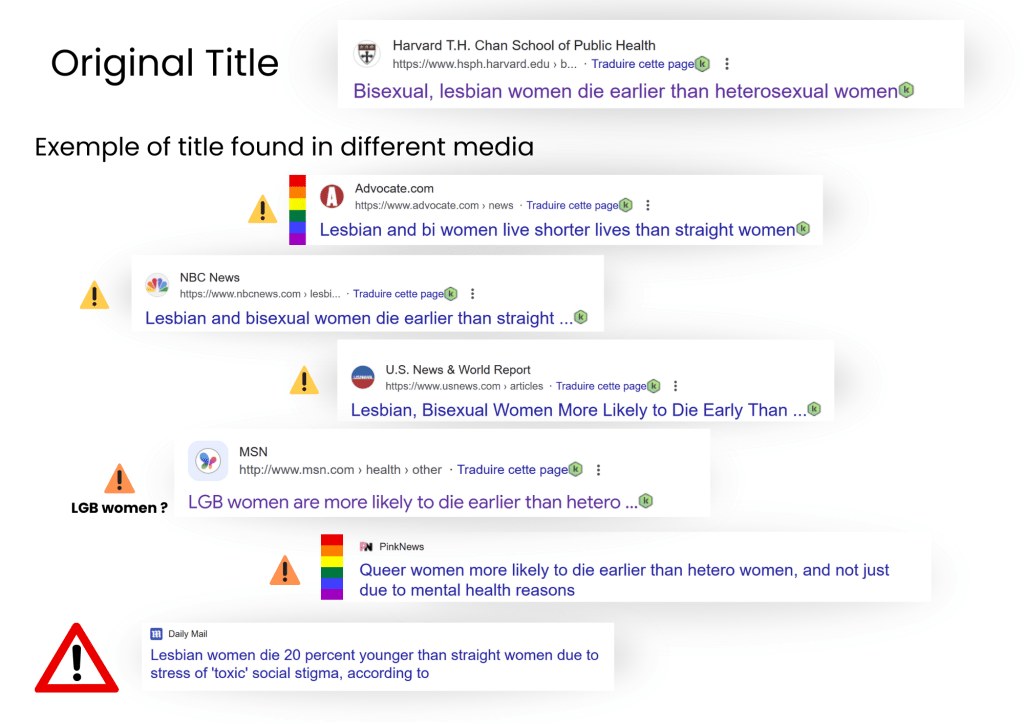
Figure 15: Media Coverage of Bisexual Women’s Overmortality , A Case of Bi Erasure
LGBT media largely followed suit. Of the five queer outlets that reported on the study, only one, Q Voice News, named bisexual women first. PinkNews stands out for its confusion and misinformation. On May 5, 2024, it ran a headline that erased bisexual women entirely: “Queer women more likely to die earlier than hetero women, and not just due to mental health reasons”. The article was filed under the site’s “lesbian” category.
The subheading immediately following the article’s title used the absurd phrase “LGB women,” as if gay men were queer women like any other. This, despite the fact that researcher Sarah McKetta granted them a video interview, available as an embedded clip, where she explicitly emphasized the plight of bisexual women in particular. Nevertheless, the journalist in question delivered a confused narrative filled with misinformation and ambiguity. She conflated statistical findings, including lesbians within the data pertaining to bisexual women’s mortality. She stated that lesbians and bisexual women are more likely to die earlier than heterosexual women, reaching a 37% increased mortality rate compared to straight women. But 37% is the figure specific to bisexual women. According to the study, lesbians face a 20% higher risk of premature death, and when bisexual and lesbian women are grouped together, the combined figure is 26%.
Accurate statistics do appear later in the article, buried in a confusing paragraph that never clearly explains that bisexual women don’t just die earlier than straight women, but also earlier than lesbians. I seriously doubt this is a matter of mathematical incompetence. McKetta’s interview is crystal clear about the specific vulnerability of bisexual women and the role of biphobia in their health outcomes, her comments focus almost entirely on this population.
Tableau 1: Title of articles that speak about McKetta et al., 2024 about bisexual and lesbian overmortality from April 2024 to decembre 2024. LGBT media are signaled by a (*).
So when people tell me there’s no need for bisexual activism, that the broader LGBTQ+ community is sufficient, I want them to take a close look at how LGBT media outlets have handled what may be the most important piece of information about bisexual health of our time.
Bisexual activists were not surprised by the mortality statistic. For years, separate studies focused on bisexual women have consistently shown their heightened vulnerability relative to both gay men and lesbians. But the bisexual community, lacking resources, does not have the means to relay and defend scientific information to the public. This too is what sabotage looks like, when the information exists, but bisexual people have neither their own media nor a meaningful seat at the table within LGBT platforms. Media institutions are extremely efficient at perpetuating widespread ignorance.
I should add that this catastrophic mishandling of the information did not only harm the bisexual community, it also harmed the lesbian community. When a Harvard study spanning 30 years and over 100,000 individuals finds that lesbians die 20% earlier than heterosexual women, one would expect a seismic reaction. Lesbian organizations, governments, activists around the globe should have sounded the alarm. But nothing happened. Why?
My theory is that the bisexual statistic discredited the entire study in the eyes of the public. Most people don’t even know biphobia exists. So when a study claims that bisexual women die earlier than lesbians, to an uninformed audience, it just sounds incoherent. Embarrassed, the media reshuffled the story, putting lesbians first in the headline, because, well, let’s not get carried away, and left it at that. Andrew Gelman, a statistician at Columbia University (Harvard’s academic rival), even rushed to publish a blog post trying to discredit the study, claiming there probably is no elevated mortality for queer women at all, and that it was likely just a smoking-related issue (Gelman, 2024). His argument was backed by no counter-analysis; much of his post consisted of complaints about not having free access to the dataset of 100,000 nurses, and therefore being unable to verify the findings. His blog post nevertheless stayed on the first page of Google results for months when one searched “bisexual women die earlier.”
So what exactly did lesbians of the 1970s gain by sabotaging the bisexual community? The consequences are still with us in 2024, and they now harm the lesbian community itself. I take no pleasure in this. Bisexuals have always fought against homophobia. We had no choice; it affects us too. We were there in the liberation movements. In a way, I feel angry that lesbian distrust of bisexuals has also cost us progress in the fight against homophobia, a fight I am equally invested in. I have nothing to gain from lesbian oppression, it harms me too.
I don’t believe this is about stupidity or malice. Just as dual nationals are routinely scapegoated in times of war, bisexuals are cast aside when homophobia resurges, because it feels “logical,” or because it offers some short-term advantage to those in power. And yet, I sincerely believe there is a smarter way forward, one that allows for alliance-building, cooperation, and mutual benefit between our two oppressed communities.
Why Do Bisexual Women Die Earlier Than Lesbians?
In the war waged by heterosexuality against homosexuality, a segment of homosexual women has been cast out by the LGBT community itself. Because they resemble “the enemy,” bisexual women have been oppressed, and their efforts to organize politically have been discouraged, from the 1970s to the present day. The rhetoric that shames the desire to advocate for one’s basic rights persists within the community, continuing to subject today’s bisexual activists to debilitating and traumatic harassment campaigns. The delay in community autonomy, which I estimate at approximately forty years, has prevented the dissemination of crucial information to both the general public and to bi and pan individuals. This delay also perpetuates the pattern where politically engaged bisexual women find themselves entering the LGBT community primarily through lesbian spaces, spaces that are ill-suited to their needs and continue to harm them.
Bisexual women thus remain isolated in society, even though they are homosexual women, and must confront homophobia just as all homosexual women do. In addition, they face biphobia, manifested in both interpersonal and institutional settings, which reflects the structural logic of how dual nationals are treated in times of war: with suspicion and exclusion.
A U.S.-based study has shown that while stigma against gay men and lesbians has gradually decreased over time, stigma toward bisexual individuals has not (Dodge et al., 2016). This finding is unsurprising. Activism by gay, lesbian, and bisexual communities has succeeded in fighting back against homophobia, but biphobia will not magically disappear without focused effort and organizing. If homophobia originally gave rise to biphobia, the latter has since evolved, strengthened, and become a distinct form of oppression. Fighting homophobia alone is not enough to eradicate biphobia. To build a society free from biphobia, we need both homosexual and bisexual activism (see Fig. 16).

Figure 16: Two Scenarios of Bisexual Activism – Bi People Fighting Only Homophobia, or Also Fighting Biphobia.
We now know that even the feeling of belonging to the LGBT community is enough to improve mental health outcomes (Lefevor et al., 2024). In other words, one doesn’t even have to participate in LGBT spaces to benefit psychologically, it’s enough to simply know that one belongs. Yet bisexual women are still subject to messages that deny or condition their inclusion, messages that persist even when they are in same-gender relationships (see chapter: Minimization of the Homophobia Experienced by Bi Women in Lesbian Relationships). Another study has shown that it is bisexual women’s isolation that determines whether minority stress will push them toward suicidality (Mereish et al., 2017). Bi women need to know that they are part of the broader queer family, and they need spaces of their own. Their isolation is killing them. The delayed inclusion of bisexual women in the LGBT community is not a neutral issue, it has real and deadly consequences.
While lesbians today often have access to community spaces that offer refuge and a sense of belonging, bisexual women lack such a community. They lack the resources and information necessary to navigate the violence they experience. They are left isolated in their sexual and psychological development. They internalize the negative stereotypes directed at their identity. Today’s bisexual women are lagging behind lesbians in terms of community access, political representation, and psychosocial support. They are isolated and under constant stress in a society hostile to their minority. They endure both lesbophobic and biphobic violence, and must do so without a community to rely on.
Is anyone really surprised that, in this context, bisexual women cope with stress using the tools they have access to, that they smoke more (Shokoohi et al., 2021) and suffer more from addiction (Shultz et al., 2022)? Is it surprising that bisexual women who are under chronic stress, smoke, and use substances are more likely to develop health conditions (Feinstein & Dyar, 2017; Caseres et al., 2017)? Is it surprising that they have higher suicide rates (Pompili et al., 2014; Salway et al., 2019)?
I do not agree with the hypothesis proposed by some researchers of a “double minority stress” model for bisexual people. The issue isn’t just that bisexuals face biphobia both in wider society and within the LGBT community, and that the two compound each other. The core problem is that they face this oppression alone. And I want to place strong emphasis on this point: the difference between bisexual women and lesbians is that bisexual women are isolated, whereas lesbians are not. The real problem is the sabotaging of bisexual autonomous organizing, and the ongoing exclusion of bi people from the LGBT community.
As homophobia declines, thanks to the tireless activism of gay, lesbian, and bi/pan activists, part of the burden weighing on the bisexual community is lifted. Bi people still face biphobia, but they face less homophobia. They can begin to gather strength to revive bisexual activism, and they’re increasingly succeeding. Since 2023, we’ve seen a growth in bi organizing here in France, with the creation of several new collectives. I’ve seen similar renewal in other European countries during my participation in the Bisexual Research international scientific conference. I believe we may be reaching a tipping point, where the forces that attack us are no longer stronger than our collective rage, and more and more bi people can advocate for bisexuality on their own terms.
Robyn Ochs has led a vital fight for bisexual visibility. Shiri Eisner has challenged us to think critically about systemic bi oppression. I believe the current struggle lies in building an autonomous community for bi and pan women, and we are now living in a historical moment where that goal feels achievable. I hope that bi and pan men will also find the strength to organize, and that we will be able to forge alliances. Unless, of course, their specific oppression ends up pushing them more naturally toward alliance with gay men.
In activist spaces, we often celebrate those who write books, craft theories, speak eloquently, and think quickly. While that part of activism is valuable and necessary, I believe we need to reevaluate the importance of bisexual women who take care of other bi people. Those who facilitate support groups, bring bi people together, offer emotional care, and help build self-worth and pride in a world that devalues them. We must recognize and uplift the person who makes us feel welcome in a group, who defends it, who does the invisible work of holding space, de-escalating conflict, or taking hits when we’re attacked. Starhawk has already theorized the importance of multiple community roles and the dangers of valuing only our intellectuals (Starhawk, 2021).
On the lesbian side, support is possible. One path is to allow bisexual women to self-identify and come together within lesbian spaces. This approach can create bi-lesbian autonomous spaces within the broader lesbian community. However, this will be ineffective if some lesbians continue to reject bisexuals’ right to speak about their experiences of violence, or to minimize those experiences. Publicly taking a stand against mockery of bi people or bi activism is undoubtedly one of the most powerful ways to resist the sabotage of bisexual organizing. I’m fully aware that lesbian allies are also often discouraged and humiliated when they support bi people, and that not all of them are in a position to do so without consequence. But I believe some will do it. I’ve already seen several speak up in support of bisexuals, their autonomy, and their rightful inclusion. I’ve seen them set aside their ego and sit with the discomfort of listening to us express the pain we often feel when navigating lesbian spaces.
Personally, I hold onto the hope of bisexual autonomy and a bi-lesbian alliance. I believe bi people will build a strong community, because they deserve one, and they are fully capable of creating it.
Bibliography
Andaloro, A. (2024). Madonna’s Ex Jenny Shimizu Felt ‘Like a High Class Hooker’ While Dating the Singer: ‘So Crazy and Fun’. People. https://people.com/madonna-ex-jenny-shimizu-felt-like-a-high-class-hooker-dating-superstar-8717044
Amherst, M. (2018). Go the Way Your Blood Beats: On Truth, Bisexuality & Desire. Repeater.
Armstrong, E. (2014). Traitors to the cause? Understanding the lesbian/gay “bisexuality debates”. In Bisexual politics (pp. 199-218). Routledge.
Belzile, J. M. (2021). Metis pour certains, usurpateurs pour d’autres. Radio Canada. https://ici.radio-canada.ca/recit-numerique/1547/peuple-autochtone-metis-canada-usurpateurs (Accessed 01/02/2025).
Benoit, C. (2019). Vietnam’s » Boat People ». In The third Indochina conflict (pp. 139-162). Routledge.
Bermea, A. M., van Eeden-Moorefield, B., & Khaw, L. (2018). A systematic review of research on intimate partner violence among bisexual women. Journal of Bisexuality, 18(4), 399-424.
Bousquet, M. P. (2012). Êtres libres ou sauvages à civiliser ? L’éducation des jeunes Amérindiens dans les pensionnats indiens au Québec, des années 1950 à 1970. Revue d’histoire de l’enfance «irrégulière». Le Temps de l’histoire, (14), 162-192.
Bowen et al., 2012. 40 years of LGBTQ philanthropy. 1970-2010. https://lgbtfunders.org/wp-content/uploads/2018/04/40years_lgbtqphilanthrophy.pdf (Accessed 12/28/2024)
Bowling, J., & Fritz, N. (2021). Binegative myths in pornography: An examination of sexual behaviors and aggression by sexual identity categories. Journal of Bisexuality, 21(2), 262-280.
Brouland, P. (2017). Les Allemands des Sudètes : un drame ignoré: leur expulsion après la IIe Guerre mondiale.
Caceres, B. A., Brody, A., Luscombe, R. E., Primiano, J. E., Marusca, P., Sitts, E. M., & Chyun, D. (2017). A systematic review of cardiovascular disease in sexual minorities. American journal of public health, 107(4), e13-e21.
Campet, S. (2002). Rencontre du « troisième sexe »: le cas du raerae tahitien. Anthropologie sociale et ethnologie. Dumas-00434449
Cerf, P. (2007). La domination des femmes à Tahiti: des violences envers les femmes au discours du matriarcat. Au vent des îles.
Collectif Famille·s (2023). Le dédale de la parentalité trans. https://collectiffamilles.com/le-dedale-de-la-parentalite-trans/
Correro, A. N., & Nielson, K. A. (2020). A review of minority stress as a risk factor for cognitive decline in lesbian, gay, bisexual, and transgender (LGBT) elders. Journal of Gay & Lesbian Mental Health, 24(1), 2-19.
Cumming, P. E. (2007). Digital ‘Reception’: Hearing ‘Stereo’ in Matilda through Children’s Web-Based Reader Response. Digital Studies/le Champ Numérique, (10). DOI: http://doi.org/10.16995/dscn.255
D’augelli, A. R., & Hershberger, S. L. (1993). Lesbian, gay, and bisexual youth in community settings: Personal challenges and mental health problems. American journal of community psychology, 21(4), 421-448.
Dilcrah (2022). Rapport d’enquête biphobie panphobie 2022. https://www.dilcrah.gouv.fr/ressources/rapport-denquete-biphobie-panphobie-2022 (Accessed 12/28/2024)
Dodge, B., Herbenick, D., Friedman, M. R., Schick, V., Fu, T. C., Bostwick, W., … & Sandfort, T. G. (2016). Attitudes toward bisexual men and women among a nationally representative probability sample of adults in the United States. PloS one, 11(10), e0164430.
Eisner, S. (2013). Bi: Notes for a bisexual revolution. Seal Press. Chapitre : Monosexism and Biphobia. Sous-chapitre : Monosexual privilege checklist
Eliason, M. J. (1997). The prevalence and nature of biphobia in heterosexual undergraduate students. Archives of sexual behavior, 26, 317-326.
Feinstein, B. A., & Dyar, C. (2017). Bisexuality, minority stress, and health. Current sexual health reports, 9, 42-49.
Flanders, C. E., Anderson, R. E., Tarasoff, L. A., & Robinson, M. (2019). Bisexual stigma, sexual violence, and sexual health among bisexual and other plurisexual women: A cross-sectional survey study. The Journal of Sex Research.
Friedman, M. R., Dodge, B., Schick, V., Herbenick, D., Hubach, R. D., Bowling, J., … & Reece, M. (2014). From bias to bisexual health disparities: Attitudes toward bisexual men and women in the United States. LGBT health, 1(4), 309-318.
Geisser, V. (2016). Une controverse peut en cacher une autre : Les binationaux suspects «ici et là-bas» ? Migrations société, 28(1), 3-12.
Gelman A. (2024). Article de Blog : Does this study really show that lesbians and bisexual women die sooner than straight women? Disparities in Mortality by Sexual Orientation in a Large, Prospective JAMA Paper. https://statmodeling.stat.columbia.edu/2024/04/30/disparities-in-mortality-by-sexual-orientation-in-a-large-prospective-jama-paper/ (Accessed 12/25/2024)
Hertlein, K. M., Hartwell, E. E., & Munns, M. E. (2016). Attitudes toward bisexuality according to sexual orientation and gender. Journal of Bisexuality, 16(3), 339-360.
Hoy-Ellis, C. P. (2023). Minority stress and mental health: A review of the literature. Journal of Homosexuality, 70(5), 806-830.
Karlan, S. (2016). Let’s Find Out Who Was Really The Most Hated Chararcter On “The L Word”. Buzzfeed. https://www.buzzfeed.com/skarlan/jenny-or-tina-ok
Lacombe, P. (2008). Les identités sexuées et ‘le troisième sexe’à Tahiti. Cahiers du genre, 45(2), 177-197.
Langevin-Duval, C. (1979). Condition et statut des femmes dans l’ancienne société maohi (îles de la Société). Journal de la Société des Océanistes, 35(64), 185-194.
Lear, A. (2013). Ancient pederasty: an introduction. A companion to Greek and Roman sexualities, 102-127.
Lefevor, G. T., Sorrell, S. A., Skidmore, S. J., Huynh, K. D., Golightly, R. M., Standifird, E., … & Call, M. (2024). When connecting with LGBTQ+ communities helps and why it does: A meta-analysis of the relationship between connectedness and health-related outcomes. Psychological Bulletin, 150(11), 1261.
Li, M., Chau, K., Calabresi, K., Wang, Y., Wang, J., Fritz, J., & Tseng, T. S. (2024). The Effect of Minority Stress Processes on Smoking for Lesbian, Gay, Bisexual, Transgender, and Queer Individuals: A Systematic Review. LGBT health.
Lind-Westbrook J. (2020). Cruel Intentions: 10 Most Shocking Scenes, Ranked. Screen Rant https://screenrant.com/cruel-intentions-stunning-controversial-moments/ (Accessed 12/28/2024)
Logan T. E. (2020). Les expériences des Métis dans les pensionnats indiens. L’encyclopédie Canadienne.
Martinez, Q. (2023). Agression transphobe à Tahiti, l’état appelé à ne pas oublier les LGBT de Polynésie. Têtu. https://tetu.com/2023/05/12/violence-agression-femme-trans-tahiti-lgbt-polynesie-francaise/
Maskell, E. (2024). What is a ‘Bambi lesbian’ and how is the term related to asexuality? Pink News. https://www.thepinknews.com/2024/04/24/what-is-a-bambi-lesbian-and-how-is-the-term-related-to-asexuality/ (Accessed 12/28/2024)
Masters, K. (2023). Why Tahiti is a paradise for your LGBT+ clients. Ttg media. https://www.ttgmedia.com/features/why-tahiti-is-a-paradise-for-your-lgbt-clients-40554
McKetta, S., Hoatson, T., Hughes, L. D., Everett, B. G., Haneuse, S., Austin, S. B., … & Charlton, B. M. (2024). Disparities in mortality by sexual orientation in a large, prospective cohort of female nurses. JAMA.
Mereish, E. H., Katz-Wise, S. L., & Woulfe, J. (2017). Bisexual-specific minority stressors, psychological distress, and suicidality in bisexual individuals: The mediating role of loneliness. Prevention science, 18(6), 716-725.
MG 2023. Violences homophobes en Polynésie : Karel Luciani interpelle l’Etat. France Tv info. https://la1ere.francetvinfo.fr/polynesie/tahiti/polynesie-francaise/violences-homophobes-en-polynesie-karel-luciani-interpelle-l-etat-1420631.html
Montillier Tetuanui N., (2013) Lahu et raerae d’hier à aujourd’hui. https://www.hiroa.pf/2013/08/mahu-et-raerae-dhier-a-aujourdhui/ (Accessed 12/29/2024)
Morrigan, C. (2024). Women twist the knife. https://www.clementinemorrigan.com/p/women-twist-the-knife (Accessed 12/29/2024)
Mulick, P. S., & Wright Jr, L. W. (2002). Examining the existence of biphobia in the heterosexual and homosexual populations. Journal of Bisexuality, 2(4), 45-64.
Mulick, P. S., & Wright Jr, L. W. (2002). Examining the existence of biphobia in the heterosexual and homosexual populations. Journal of Bisexuality, 2(4), 45-64.
Nagoshi, C. T., Bechky, A., Nagoshi, J., & Pillai, V. K. (2023). For straight persons, correlates of biphobia are mostly the same as for homophobia. Journal of Bisexuality, 23(2), 115-125.
Nelson, R. (2024). Deconstructing the Clinging Myth of ‘Straight-Passing privilege’for bi+ People. Journal of Bisexuality, 1-22.
Obradors-Campos, M. (2011). Deconstructing biphobia. Journal of Bisexuality, 11(2-3), 207-226.
Ochs, R. (1996). “Biphobia: It Goes More than Two Ways.” Bisexuality: The Identity and Politics of an Invisible Minority, Firestein, Beth. (ed.) Sage Publications, 1996.
Ochs, R. (date inconnue). Quotes. https://www.robynochs.com/quotes (Accessed 12/28/2024)
Pompili, M., Lester, D., Forte, A., Seretti, M. E., Erbuto, D., Lamis, D. A., … & Girardi, P. (2014). Bisexuality and suicide: A systematic review of the current literature. The journal of sexual medicine, 11(8), 1903-1913.
Precarité Inclusive (2022). Politisation Plurisexuelle. Plurisexualité Monosexualité.
Precarité Inclusive (2022). Sexualité et Mesure : La bisexualité en question.
Precarité Inclusive (2023). Livres et Plurisexualité. A la recherche des Bi et Pan. https://www.instagram.com/precarite_inclusive/ (Accessed 12/28/2024).
Proctor, C. D., & Groze, V. K. (1994). Risk factors for suicide among gay, lesbian, and bisexual youths. Social work, 39(5), 504-513.
Resa, F. (2021). Les meufs bi en couple avec un mec ont besoin d’une communauté https://www.instagram.com/p/CUILfmws1Zf/?img_index=1 (Accessed 12/28/2024).
Resa, F. (2021). Les violences conjugales LGBTQ+ https://youtu.be/Qf7wyTMH_1U?si=zUcbfti67WY85shZ (Accessed 12/28/2024).
Resa, F. (2021). Vidéo trop dense sur les violences conjugales LGBTQ+ https://youtu.be/O4yPz0_-5YU?si=mqVSrY-SpLuVFM4u (Accessed 12/28/2024).
Resa, F. (2022). Trauma religieux chez les personnes bi et pan. https://youtu.be/IfznVjf9WAA?si=6M-Cgb_9FYOvqf5z (Accessed 12/28/2024).
Resa, F. (2023). Menacer sa partenaire ou ex-partenaire de l’outer c’est des violences conjugales. Communauté Bisexuelle. https://www.instagram.com/p/CtywwxItnfS/?img_index=1 (Accessed 12/28/2024).
Resa, F. (2023). Si les bi sont dans le placard au taff, c’est clairement pas parce qu’elles aiment pas leur meuf. https://www.instagram.com/p/CrB09O9LNI8/?img_index=1 (Accessed 12/28/2024).
Resa, F. (2024). Les bi sont-elles solubles dans le matérialisme ? Et autres questions philosophiques pour twitter. https://www.instagram.com/p/C4fxbOrtQ9h/?img_index=1 (Accessed 12/28/2024).
Resa, F. (2024). Les bisexuelles plus vulnérables que les lesbiennes et les hétéros ? Des sources. https://www.instagram.com/p/DCRGwKFNuWC/?img_index=1 (Accessed 12/28/2024).
Robinson, G. (2012). Un drame de la Deuxième Guerre mondiale : Le sort de la minorité japonaise aux États-Unis et au Canada. Les Presses de l’Université de Montréal.
Rose, S. (2022). How Lani Ka’ahumanu propelled Bisexual+ Visibility. Blurred Bylines. https://blurredbylines.com/articles/lani-kaahumanu-bisexual-activism-san-francisco-lgbtq/ (Accessed 12/28/2024)
Ross, L. E., & Costa, L. (2021). “Slighted and Unheard”: The Psychiatrization of Bisexuality. Interrogating psychiatric narratives of madness: Documented lives, 87-110.
Ross, L. E., O’Gorman, L., MacLeod, M. A., Bauer, G. R., MacKay, J., & Robinson, M. (2016). Bisexuality, poverty and mental health: A mixed methods analysis. Social Science & Medicine, 156, 64-72.
Ross, L. E., Salway, T., Tarasoff, L. A., MacKay, J. M., Hawkins, B. W., & Fehr, C. P. (2018). Prevalence of depression and anxiety among bisexual people compared to gay, lesbian, and heterosexual individuals: A systematic review and meta-analysis. The journal of sex research, 55(4-5), 435-456.
Salim, S. R., Eshelman, L. R., & Messman, T. L. (2022). Binegativity exacerbates the effects of sexual victimization disclosure on posttraumatic stress and drinking among bisexual women. Journal of interpersonal violence, 37(21-22), NP19939-NP19960.
Salway, T., Ross, L. E., Fehr, C. P., Burley, J., Asadi, S., Hawkins, B., & Tarasoff, L. A. (2019). A systematic review and meta-analysis of disparities in the prevalence of suicide ideation and attempt among bisexual populations. Archives of sexual behavior, 48, 89-111.
Serano, J., (2016). Glossary. Outspoken: A Decade of Transgender Activism and Trans Feminism. Switch Hitter Press.
Serano, J. (2021). Transgender people, bathrooms and sexual predators, what data say? https://juliaserano.medium.com/transgender-people-bathrooms-and-sexual-predators-what-the-data-say-2f31ae2a7c06 (Accessed 01/10/2025).
Schulz, C. T., Glatt, E. M., & Stamates, A. L. (2022). Risk factors associated with alcohol and drug use among bisexual women: A literature review. Experimental and clinical psychopharmacology, 30(5), 740.
Sejean, N. (date inconnue). Circulation. https://nathaliesejean.substack.com/about (Accessed 12/28/2024).
Shaw, J. (2022). Bi: The hidden culture, history and science of bisexuality. Canongate Books.
Shokoohi, M., Salway, T., Ahn, B., & Ross, L. E. (2021). Disparities in the prevalence of cigarette smoking among bisexual people: a systematic review, meta-analysis and meta-regression. Tobacco Control, 30(e2), e78-e86.
Smith J. (2022). Emma Thompson’s Matilda Casting Controversy Explained (Is It Fair?). Screen Rant https://screenrant.com/emma-thompson-matilda-casting-controversy/
Squires, T. (2019). The unicorn scale: L-word. Bi.org https://bi.org/en/articles/the-unicorn-scale-the-l-word (Accessed 12/18/2024)
Starhawk (2021). Comment s’organiser ? Manuel pour l’action collective. Editions Cambourakis.
Stip, E. (2015). Les RaeRae et Mahu : troisième sexe polynésien. Santé mentale au Québec, 40(3), 193-208.
Stokely C., Hamilton C.V. (1967). Black Power: The Politics of Liberation in America. Random House.
Subwaytakes (2024). Episode 215 : A lot of QUEER people are leading HETERO lives!! Par Kareem Rahma. Subway Takes.
Taylor, S. R. (2021). The body is not an apology: The power of radical self-love. Berrett-Koehler Publishers. Citation: [Systems do not maintain themselves; even our lack of intervention is an act of maintenance. Every structure in every society is upheld by the active and passive assistance of other human beings.]
Taywaditep, K. J. (2002). Marginalization among the marginalized: Gay men’s anti-effeminacy attitudes. Journal of homosexuality, 42(1), 1-28.
Ten Eyck, M. (2015). Everything The L Word Fucked Up. Every Queer. https://everyqueer.com/everything-the-l-word-fucked-up/ (Accessed 12/18/2024)
Tomasik, E. (2024). For pride month 6 facts about bisexual americans. Pew Center Research. https://www.pewresearch.org/short-reads/2024/06/28/for-pride-month-6-facts-about-bisexual-americans/ (Accessed 12/28/2024)
Turell, S. C., Brown, M., & Herrmann, M. (2018). Disproportionately high: An exploration of intimate partner violence prevalence rates for bisexual people. Sexual and Relationship Therapy, 33(1-2), 113-131.
Verstraete, B. C. (1980). Slavery and the social dynamics of male homosexual relations in ancient Rome. Journal of Homosexuality, 5(3), 227-236.
Wang, Y. (2025). Stigmatization of the “bottom” role by content creators and audiences on Bilibili. In Global Dialogue on Media Dynamics, Trends and Perspectives on Public Relations and Communication (pp. 338-343). CRC Press.
Welzer-Lang, D. (2008). Speaking out loud about bisexuality: Biphobia in the gay and lesbian community. Journal of Bisexuality, 8(1-2), 81-95.
Wohosheni (2023). N°1. Pourtant la bisexualité. La newsletterbie. https://lanewsletterbie.wordpress.com/2023/05/02/no-1-pourtant-la-bisexualite/ (Accessed 12/28/2024)
Wohosheni (2024) (a). N°9. Quelle bisexualité politique ? (4) En France au tournant des années 70 : … révolutions du FHAR. La newsletterbie. https://lanewsletterbie.wordpress.com/2024/05/21/no-9-quelle-bisexualite-politique-4-en-france-au-tournant-des-annees-70-revolutions-du-fhar/
Wohosheni (2024) (b). N°11. Quelle bisexualité politique ? (5) Sortir de l’hétéronormativité, partie I : Replacer la bisexualité sur l’échiquier. La newsletterbie. https://lanewsletterbie.wordpress.com/2024/12/02/no-11-quelle-bisexualite-politique-5-sortir-de-lheteronormativite-partie-i-replacer-la-bisexualite-sur-lechiquier/
Worthen, M. G. (2016). Sexual deviance and society. London, United Kingdom: Routledge.
Yoshino, K. (2000). The epistemic contract of bisexual erasure. Stanford Law Review. Volume: 52 Issue: 2 Page: 353
Zane, Z. (2016). Q&A: Bisexual Activist Robyn Ochs On Bi-visibility, Erasure, And The Future Of The Bi+ Movement. Huffington Post. https://www.huffpost.com/entry/qa-bisexual-activist-robyn-ochs-on-bi-visibility_b_577ec159e4b0f06648f4111a (Accessed 12/28/2024)
Zeilinger, I. (2023). La biphobie, étude. Garance https://www.garance.be/ressource/etude-la-biphobie/ (Accessed 12/28/2024)
Appendix: Methodology for Research on Publications Containing the Keywords “bisexual,” “lesbian,” “gay,” and “homosexual,” and Corresponding Raw Data
Researching the number of academic publications that include or exclude the keywords “bisexual,” “lesbian,” “gay,” and “homosexual” presents a number of methodological challenges:
- The keyword “bisexual” includes many articles where the term refers not to sexual orientation, but to mythological representations of hermaphroditism or intersex bodies, mathematical branching theory, or hermaphroditic reproductive mechanisms in plant and animal biology. As such, the term frequently returns irrelevant results unrelated to bisexuality as a sexual orientation.
- The keyword “gay” generates a large volume of unrelated results, including papers authored by individuals named “Gay”, a common first name in the U.S. prior to its association with homosexuality, as well as studies on the work of the chemist and physicist Gay-Lussac, or the poet John Gay. This bias is especially pronounced in literature from the 1960s and 1970s.
- The keyword “lesbian” originally referred to inhabitants of the island of Lesbos. As such, some results titled with “lesbian” deal with topics such as Hellenic poetry. However, “lesbian” tends to be a more reliable and linguistically stable term than “gay” or “bisexual” for identifying publications on sexual orientation.
- The keyword “homosexual” presents no such linguistic ambiguity and is a reliable marker of sexual orientation-related content.
An alternative method, searching for “bisexual” and excluding results containing terms associated with biology or taxonomy (e.g., “species,” “animal,” “taxonomic,” “race”), was abandoned. This approach inadvertently excluded numerous relevant articles, particularly those dealing with the intersections of homophobia and racism or the animalization of sexual minorities, while still allowing in unrelated studies despite increasingly refined exclusion filters. Therefore, a different methodology was prioritized.
One useful method involved excluding publications authored by individuals whose given or family name includes “Gay.” This filter was successfully applied to searches using the “gay” keyword.
Search Protocol
Searches were conducted via scholar.google.com, using Boolean operators and inclusion/exclusion syntax as outlined in Table A. These codes enabled a preliminary query using keywords without initially addressing linguistic ambiguity.
All searches excluded patents and citations and were performed by decade, starting with 1960–1969 and continuing through 2010–2019. For each decade, the first page of search results was manually reviewed to estimate the proportion of non-relevant articles due to keyword ambiguity. This proportion was then applied as a correction factor to the rest of the dataset. The process for applying this correction is illustrated in Figure A. Raw and adjusted results are available in Table B. Data from 2020–2025 are included for reference but are not displayed in graphical analyses since they do not represent a complete decade. A simple linear regression is used to extrapolate publication trends across decades, with no smoothing applied to the dataset.
Methodological Limitations
The term “gay” is used in English to refer specifically to homosexual men but is also used across multiple languages without translation. In contrast, “homosexual,” “lesbian,” and “bisexual” often appear in slightly different forms in other languages. As a result, publication counts for “gay” are likely overestimated, due to inclusion of non-English language articles, a limitation that does not apply equally to the other terms. This should be considered when interpreting the final results.
Table A: Search Syntax and Keyword Parameters by Category
| Type of article | Text typed in the research engine scholar.google | Key word present in the title | Key word absent from the title | Key word present in the article | Key word absent from the article |
| Inclusion | intitle: »bisexual » men | bisexual | – | men, man | – |
| intitle: »bisexual » women | bisexual | – | women, woman | – | |
| intitle: »gay » -author: »gay » | gay | – | – | – | |
| intitle: »homosexual » | homosexual | – | – | – | |
| intitle: »lesbian » | lesbian | – | – | – | |
| intitle: »bisexual » | bisexual | – | – | – | |
| Thematic | intitle: »bisexual » -intitle: »lesbian » -intitle: »lesbians » -intitle: »gay » -intitle: »gays » -intitle: »homosexual » -intitle: »homosexuals » -intitle: »homo » | bisexual | lesbian, lesbians, gay, gays, homosexual, homosexuals, homo | – | – |
| intitle: »gay » -intitle: »bisexual » -intitle: »bisexuals » -intitle: »bi » -intitle: »lesbian » -intitle: »lesbians » | gay | bisexual, bisexuals, bi, lesbian, lesbians | – | – | |
| intitle: »homosexual » -intitle: »bisexual » -intitle: »bisexuals » -intitle: »bi » | homosexual | bisexual, bisexuals, bi | – | – | |
| intitle: »lesbian » -intitle: »bisexual » -intitle: »bisexuals » -intitle: »bi » -intitle: »gay » -intitle: »gays » | lesbian | bisexual, bisexuals, bi, gay, gays | – | – | |
| Ultra specialized | intitle: »bisexual » men -gay -gays -lesbian -lesbians -homo -homosexual -homosexuals | bisexual | – | men, man | gay, gays, lesbian, lesbians, homo, homosexual, homosexuals |
| intitle: »bisexual » women -gay -gays -lesbian -lesbians -homo -homosexual -homosexuals | bisexual | – | women, woman | gay, gays, lesbian, lesbians, homo, homosexual, homosexuals | |
| intitle: »gay » -author: »gay » -lesbian -lesbians -bisexual -bisexuals -bi | gay | – | – | lesbian, lesbians, bisexual, bisexuals, bi | |
| intitle: »homosexual » -bisexual -bisexuals -bi | homosexual | – | – | bisexual, bisexuals, bi | |
| intitle: »lesbian » -gay -gays -bisexual -bisexuals -bi | lesbian | – | – | gay, gays, bisexual, bisexuals, bi |
Results:
Linguistic Ambiguity
Outside of the 1960s and 1970s, the keywords gay, lesbian, bisexual, and homosexual are generally effective for identifying scholarly articles focused on sexual orientation. The terms vary in clarity, however. Among them, the most linguistically ambiguous, ranked from most to least, is bisexual, followed by gay, then lesbian. The term homosexual presents no linguistic ambiguity, even in early decades such as the 1960s.
An illustration of how this linguistic ambiguity manifests across different decades can be found in Figure A.
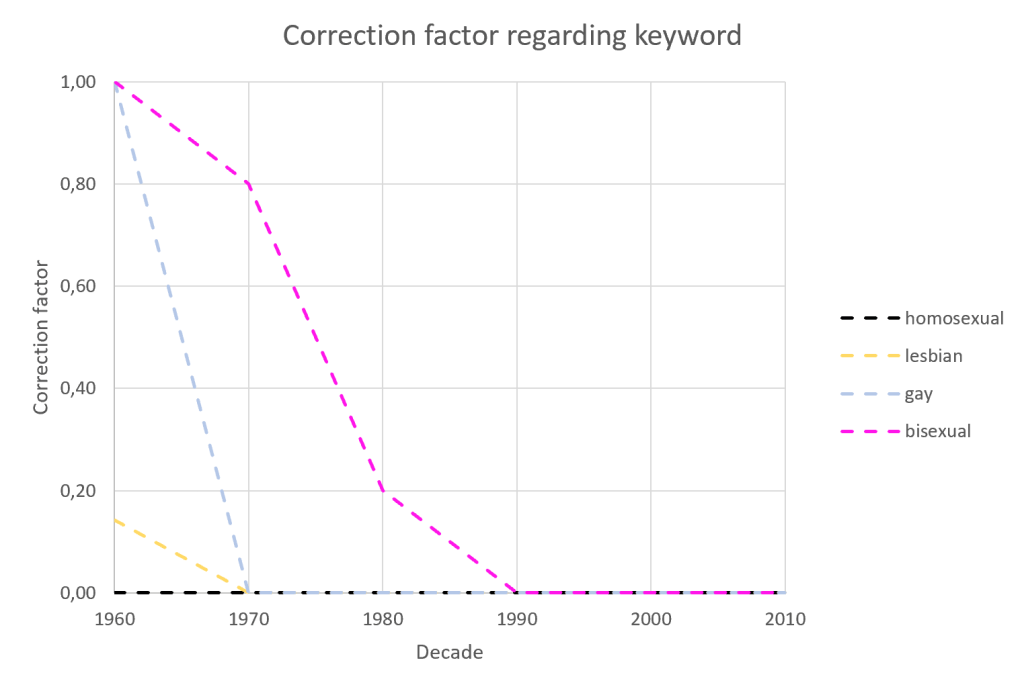
Figure A: Correction factor applied to keywords, where 1 indicates that 100% of the first-page search results are unrelated to sexual orientation, and 0 indicates that 0% of the results are unrelated to sexual orientation.
Table B: Raw data retrieved from the search engine using various keywords, presented both with and without the adjustment factor.
| Key word Group | Decade | Total number of publication | Number of article not related to sexual orientation in the 1st result page | Number of article in the 1st page | Adjusted number of publication |
| intitle: »bisexual » | |||||
| Group A | 1960 | 38 | 10 | 10 | 0 |
| 1970 | 82 | 8 | 10 | 16,4 | |
| 1980 | 158 | 2 | 10 | 126,4 | |
| 1990 | 856 | 0 | 10 | 856 | |
| 2000 | 2010 | 0 | 10 | 2010 | |
| 2010 | 4830 | 0 | 10 | 4830 | |
| 2020-2025 | 3210 | 0 | 10 | 3210 | |
| intitle: »bisexual » men | |||||
| Group B | 1960 | 12 | 10 | 10 | 0 |
| 1970 | 20 | 4 | 10 | 12 | |
| 1980 | 102 | 0 | 10 | 102 | |
| 1990 | 673 | 0 | 10 | 673 | |
| 2000 | 1730 | 0 | 10 | 1730 | |
| 2010 | 4500 | 0 | 10 | 4500 | |
| 2020-2025 | 2730 | 0 | 10 | 2730 | |
| intitle: »bisexual » women | |||||
| Group C | 1960 | 2 | 1 | 2 | 1 |
| 1970 | 8 | 3 | 8 | 5 | |
| 1980 | 54 | 0 | 10 | 54 | |
| 1990 | 516 | 0 | 10 | 516 | |
| 2000 | 1520 | 0 | 10 | 1520 | |
| 2010 | 4000 | 0 | 10 | 4000 | |
| 2020-2025 | 2420 | 0 | 10 | 2420 | |
| intitle:« bisexual » men -gay -gays -lesbian -lesbians -homo -homosexual -homosexuals | |||||
| Group D | 1960 | 11 | 10 | 10 | 0 |
| 1970 | 11 | 9 | 10 | 1,1 | |
| 1980 | 18 | 6 | 10 | 7,2 | |
| 1990 | 25 | 2 | 10 | 20 | |
| 2000 | 21 | 5 | 10 | 10,5 | |
| 2010 | 49 | 1 | 10 | 44,1 | |
| 2020-2025 | 30 | 10 | 30 | ||
| intitle: »bisexual » women -gay -gays -lesbian -lesbians -homo -homosexual -homosexuals | |||||
| Group E | 1960 | 1 | 1 | 1 | 0 |
| 1970 | 4 | 3 | 4 | 1 | |
| 1980 | 1 | 0 | 1 | 1 | |
| 1990 | 9 | 1 | 9 | 8 | |
| 2000 | 7 | 1 | 7 | 6 | |
| 2010 | 32 | 1 | 10 | 28,8 | |
| 2020-2025 | 24 | 0 | 10 | 24 | |
| intitle: »lesbian » | |||||
| Group F | 1960 | 7 | 1 | 7 | 6 |
| 1970 | 76 | 0 | 10 | 76 | |
| 1980 | 512 | 0 | 10 | 512 | |
| 1990 | 2770 | 0 | 10 | 2770 | |
| 2000 | 4810 | 0 | 10 | 4810 | |
| 2010 | 7810 | 0 | 10 | 7810 | |
| 2020-2025 | 3540 | 0 | 10 | 3540 | |
| intitle: »lesbian » -gay -gays -bisexual -bisexuals -bi | |||||
| Group G | 1960 | 2 | 1 | 2 | 1 |
| 1970 | 24 | 1 | 10 | 21,6 | |
| 1980 | 84 | 1 | 10 | 75,6 | |
| 1990 | 260 | 0 | 10 | 260 | |
| 2000 | 287 | 0 | 10 | 287 | |
| 2010 | 518 | 2 | 10 | 414,4 | |
| 2020-2025 | 303 | 0 | 10 | 303 | |
| intitle: »gay » -author: »gay » | |||||
| Group H | 1960 | 124 | 10 | 10 | 0 |
| 1970 | 363 | 0 | 10 | 363 | |
| 1980 | 900 | 0 | 10 | 900 | |
| 1990 | 4290 | 0 | 10 | 4290 | |
| 2000 | 9200 | 0 | 10 | 9200 | |
| 2010 | 15500 | 0 | 10 | 15500 | |
| 2020-2025 | 7470 | 0 | 10 | 7470 | |
| intitle: »gay » -author: »gay » -lesbian -lesbians -bisexual -bisexuals -bi | |||||
| Group I | 1960 | 120 | 10 | 10 | 0 |
| 1970 | 225 | 1 | 10 | 202,5 | |
| 1980 | 336 | 2 | 10 | 268,8 | |
| 1990 | 923 | 6 | 10 | 369,2 | |
| 2000 | 1640 | 2 | 10 | 1312 | |
| 2010 | 3300 | 5 | 10 | 1650 | |
| 2020-2025 | 1780 | 2 | 10 | 1424 | |
| intitle: »homosexual » | |||||
| Group J | 1960 | 90 | 0 | 10 | 90 |
| 1970 | 372 | 0 | 10 | 372 | |
| 1980 | 1140 | 0 | 10 | 1140 | |
| 1990 | 1370 | 0 | 10 | 1370 | |
| 2000 | 1250 | 0 | 10 | 1250 | |
| 2010 | 2070 | 0 | 10 | 2070 | |
| 2020-2025 | 962 | 0 | 10 | 962 | |
| intitle: »homosexual » -bisexual -bisexuals -bi | |||||
| Group K | 1960 | 79 | 0 | 10 | 79 |
| 1970 | 303 | 0 | 10 | 303 | |
| 1980 | 847 | 0 | 10 | 847 | |
| 1990 | 719 | 0 | 10 | 719 | |
| 2000 | 740 | 0 | 10 | 740 | |
| 2010 | 1150 | 0 | 10 | 1150 | |
| 2020-2025 | 549 | 0 | 10 | 549 | |
| intitle: »bisexual » -intitle: »lesbian » -intitle: »lesbians » -intitle: »gay » -intitle: »gays » -intitle: »homosexual » -intitle: »homosexuals » -intitle: »homo » | |||||
| Group L | 1960 | 38 | 10 | 10 | 0 |
| 1970 | 80 | 8 | 10 | 16 | |
| 1980 | 101 | 5 | 10 | 50,5 | |
| 1990 | 222 | 0 | 10 | 222 | |
| 2000 | 315 | 0 | 10 | 315 | |
| 2010 | 847 | 0 | 10 | 847 | |
| 2020-2025 | 623 | 0 | 10 | 623 | |
| intitle: »lesbian » -intitle: »bisexual » -intitle: »bisexuals » -intitle: »bi » -intitle: »gay » -intitle: »gays » | |||||
| Group M | 1960 | 7 | 2 | 7 | 5 |
| 1970 | 70 | 0 | 10 | 70 | |
| 1980 | 348 | 0 | 10 | 348 | |
| 1990 | 1390 | 0 | 10 | 1390 | |
| 2000 | 1940 | 0 | 10 | 1940 | |
| 2010 | 2920 | 0 | 10 | 2920 | |
| 2020-2025 | 1430 | 0 | 10 | 1430 | |
| intitle: »gay » -intitle: »bisexual » -intitle: »bisexuals » -intitle: »bi » -intitle: »lesbian » -intitle: »lesbians » | |||||
| Group N | 1960 | 127 | 10 | 10 | 0 |
| 1970 | 366 | 0 | 10 | 366 | |
| 1980 | 708 | 0 | 10 | 708 | |
| 1990 | 2540 | 1 | 10 | 2286 | |
| 2000 | 5780 | 0 | 10 | 5780 | |
| 2010 | 10800 | 3 | 10 | 7560 | |
| 2020-2025 | 4590 | 0 | 10 | 4590 | |
| intitle: »homosexual » -intitle: »bisexual » -intitle: »bisexuals » -intitle: »bi » | |||||
| Group O | 1960 | 90 | 0 | 10 | 90 |
| 1970 | 370 | 0 | 10 | 370 | |
| 1980 | 1110 | 0 | 10 | 1110 | |
| 1990 | 1260 | 0 | 10 | 1260 | |
| 2000 | 1210 | 0 | 10 | 1210 | |
| 2010 | 2010 | 0 | 10 | 2010 | |
| 2020-2025 | 919 | 0 | 10 | 919 | |
| SUM : Gay+Lesbian+Homosexuals (Group M + Group N + Group O) | |||||
| Group M + Group N + Group O | 1960 | 95 | |||
| 1970 | 806 | ||||
| 1980 | 2166 | ||||
| 1990 | 4936 | ||||
| 2000 | 8930 | ||||
| 2010 | 12490 | ||||
| 2020-2025 | 6939 | ||||
Lost Notes in the Lab Notebook
Cis bisexual women who are not involved in libertine or sex-positive circles tend to lack external community support. As a result, they will likely be a driving force in the formation of the bisexual community.
Trans bisexual women, for now, remain closer to trans spaces, but are active within the bi community. If we succeed in addressing our own transmisogyny, the bisexual community will benefit from the presence of individuals whose perspectives are both deeply relevant and strategically important to advancing bi rights. The alliance between cis and trans bisexual women is currently one of the most promising, but it will require effort, especially because trans women will not tolerate transphobia. Having already built a community centered on their needs, they can easily retreat from the bi community if they are not treated with respect. Shiri Eisner, citing Julia Serano in the chapter “WHY THIS? WHY NOW?”, noted the presence of biphobia aimed at cis bisexual women within trans spaces, which she attributed to the biphobia of certain trans men with lesbian backgrounds who hold influence in trans activist circles. This dual friction, between biphobia and transphobia, may be a sticking point, but I remain convinced that these are two populations with roughly equal power (due to absence of bi community and self organization of trans women. Outside of LGBT spaces, trans women have virtually no power, I am only talking about relative power in LGBT spaces with French spaces in mind, which are mostly trans-inclusive), who could form an alliance of mutual support, with trans bi women participating in both trans and bi spaces.
The power imbalance between cis bi women and cis lesbians remains too significant, for now, to build a true alliance. I hope that changes in the future. At present, the relationship between lesbians and bi women tends to rely on the goodwill of a few altruistic lesbians offering charity to bi women. But charity alone is not sufficient to provide bi women with a safe space to unlearn their internalized lesbophobia, nor to protect them from biphobia among certain lesbians. While I do not wish to discourage these supportive gestures, it is important to acknowledge their limits. Bisexual women need to build their own power in order for these relationships to become truly equitable.
Cis bisexual men currently appear as both invisible and assimilated, either within or outside the gay community, but are ready to participate in bi and pan gender neutral initiatives. They will not initiate gender neutral spaces themselves, but are likely to join in when invited, and could become important allies. They might gravitate toward a bi community if one is built by women, or alternatively, they could form their own subgroup within gay spaces, as an enclave. However, they cannot be the ones to invite bi women into these spaces, due to the prevailing gender dynamics: women often perceive male interest as flirtation. And their wariness is, unfortunately, justified by widespread male behavior: most men do not pursue friendships with women unless motivated by romantic or sexual interest. Gay men’s friendships are thus perceived as safe, while those of straight or bi men are often viewed with suspicion, because, often, the suspicion is warranted. Therefore, it seems likely that a gender neutral bi community will only form if initiated by women who then invite men in, rather than the other way around.
That said, a gender neutral bi space is only one form of bi activism. Given the unique features of bisexuality, solidarity between bi men and women must not create pressure on bi women to do the emotional or political labor for bi men. Just as the trans community maintains dedicated spaces for transmasculine, transfeminine, and nonbinary individuals, bi spaces centered on gay- or lesbian-specific concerns, or the experience of sexism in a heterosexual relationship, are also essential. I hope that cis and pan bi men will see bi feminist-led initiatives as opportunities to reflect on their own experiences and the particular dynamics of gay and straight masculinity that affect them. There is real potential for productive gender neutral activism, and a legitimate need for women-centered spaces too. Both models must coexist.
However, if these men monopolize activist energy or fail to sufficiently challenge their own sexism, bi women will likely push them out or abandon the spaces they’ve built, only to start anew without them. Just as cis bi women must confront transmisogyny in order to ally with trans bi women, bi men will need to confront sexism if they wish to build meaningful alliances with bi women. And I am not talking about individual efforts, but about structural responses embedded in organizations. A bi man may deconstruct his own sexism, but if others commit gender-based violence and drive women away, undermining the gender neutral bi community before men have built sufficient autonomy, he will be impacted regardless. Similarly, a cis bi woman may personally address her transmisogyny, but if a trans woman can be excluded at the first sign of conflict, if she is absent from leadership or discourse, she will leave. The issue is not about individual virtue, but about which groups are protected, or not, within our structures. The same applies to every other marginalized group, whether affected by racism, fatphobia, or other systems of oppression. They will leave the bi space if it is hostile to them.
Bi people in sex-positive and libertine scenes will not tolerate condescension or disdain for their perceived lack of political engagement. Since they already have communities, they will abandon bi spaces unless treated with mutual respect and offered autonomous spaces.
Our nonbinary minority suffers under gendered bi activism and often prefers a more queer-centered approach. I believe they will thrive in gender neutral bi and pan spaces.
Trans bi and pan men, in contrast, remain under-organized within trans spaces. Yet, they are often present in predominantly female bi spaces that do not fully meet their needs, particularly concerning gay dynamics or relationships with women.
Biromantic asexual people will also feel unwelcome if spaces become hypersexualized and fail to offer ace-specific environments. Given the limited structure of the ace community, some may stay, but they will suffer if their needs go unmet.
The bi community will be exceptionally complex to build, but it will gain immense strength from recognizing and supporting all of its sub-minorities.
Among all these flows, dispersals, and regroupings, I see real potential in the lesbian-spectrum bi community, especially cis and trans bi women, and a possible anchoring role for bi and pan men, if they succeed in addressing sexism on their own terms.
We have never stopped trying to organize. We’ve pushed the lid again and again. The pressure is rising. I hold immense admiration for the bi and pan community, who persist in resisting erasure, expanding, freezing under violence and humiliation, and warming when we remember who we are as a group. We are scattered, and we find each other again. We are pitted against one another, and we reforge alliances. Internal tensions are also intense. Mental illness and emotional sensitivity make us argue and fracture frequently. But I believe that, in the long arc of history, we are making progress.
I don’t believe in individual influence, the idea of one person shaping everything. You’ve seen it as I have: the number of scholarly articles on bisexuality is increasing exponentially. The continued efforts of generations of bi activists are paying off. It may be demoralizing to look at the past few years and feel that progress is too slow. But over the long term, our efforts matter. Our conditions are improving. And the trajectory of our movement follows a relatively consistent upward path. I believe we will succeed in forming and stabilizing a community.
At the same time, I see the rise of fascism and the acceleration of climate catastrophe. I fear we won’t manage to organize in time before everything collapses. But even if we fail because of time, I’ve truly loved living through and bearing witness to it all.
Table of content
Part 1 – Where Does the Conceptualization of Biphobia Stand Today?
1. Definitions ans Theoretical Contributions
Robyn Ochs : The Erasure of Bi People as an Accident of a Binary American Culture
Kenji Yoshino: The Erasure of Bisexuality as a Tool for Maintaining Norms
2. Quantifying the Effects and Establishing Scientific Consensus
Researching Biphobia: A Scientific Endeavor
The Exclusion of Bisexual People from Scientific Research
Inclusion of Bisexual People from the 1980s
The Compilation and Communication of Scientific Data: A Scientific and Activist Endeavor
A Preliminary Scientific Response: The Minority Stress Theory
Part 2 – Toward a New Theoretical Framework for the Origin of Biphobia
The Case of Dual Nationals in Wartime
The Symbolic Dual Nationals of Lesbos
Case Study: The Tahitian Context
Can a Patriarchal but Non-Homophobic Society Be Biphobic?
Biphobia in Contexts Affected by Homophobia
The Homophobic Origins of Biphobia: The Case of Invisibility
The Difference Between Bi People on the Lesbian Spectrum and Bi People on the Gay Spectrum
What Are the Consequences of Failing to Recognize the Homophobic Roots of Biphobia?
Part 3 – Biphobia and Lesbophobia: Two Distinct Forms of Oppression
Denial of the Homophobia Experienced by Bi Women in Heterosexual Relationships
Minimization of the Homophobia Experienced by Bi Women in Lesbian Relationships
The Hierarchization of Lesbian Experience: A Tool of Biphobia
Confusion and Ambiguity Between Homophobia and Biphobia
Definition of Lesbophobia and Biphobia
Sufficient and Necessary Conditions for Discrimination
Manifestations of Biphobia vs. Lesbophobia in Society: Discovering One’s Sexual Orientation
Exploitation of Bi Women’s Sexuality
Why Is This Primarily Biphobia?
Sexual Harassment Through Threesomes: Direct Oppression or Collateral Damage?
Manifestations of Biphobia vs. Lesbophobia in Romantic Relationships
Case Study: Madonna and Shimizu
The Sabotage of the Bisexual Community
Case Study: The Harassment of the Front d’Action Bisexuel (FAB)
Bisexuals Are Expected to Advocate for Others, but Not for Themselves
How Can We Measure the Delay in Bisexual Activism Caused by Sabotage?
The Lesbian Community as the Endpoint for Bi Women – and Its Consequences
The Case of Domestic Violence Support Services
Intimate Partner Violence Affecting Bisexual Women in Heterosexual Relationships
Intimate Partner Violence and Internalized Biphobia
Case Study: A Community Health Center
Case Study: How Media Institutions Handle Bisexual Overmortality
 Floralie Resa